Disease and Faith in Ukraine
by Joseph Sywenkyj
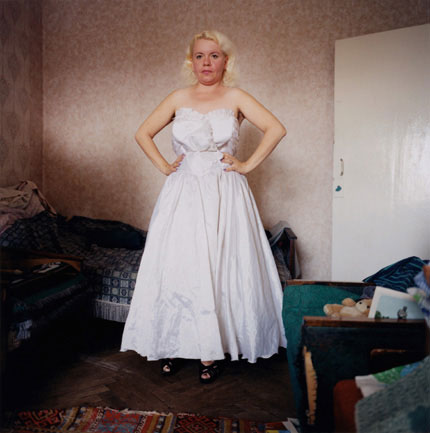
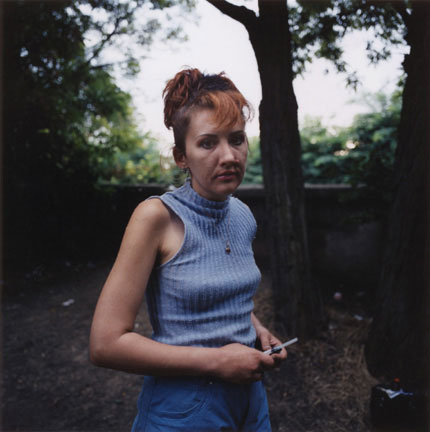
Olga
She is HIV-positive. Her husband passed away several years ago. When I arrived at her home, she immediately asked if I could take a picture of her in a dress. I said yes, and within a minute or two she returned wearing her wedding dress. This was the happiest I ever saw her. A year and a half after this photograph was taken; a family member placed it on her casket in memoriam. Kyiv, Ukraine 2001
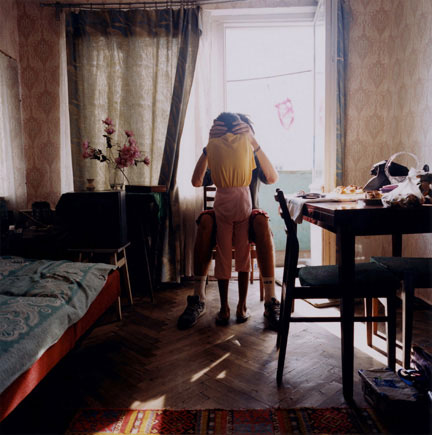
Arnold is receiving a checkup from Dr. Konstantin Lezhentsev, a doctor working for Medecins Sans Frontieres / Doctors without Borders. Dr. Konstantin visits several times a month giving free checkups and medicine to Arnold and his mother. He suspects they may already have full-blown AIDS and told me he hopes they both make it through the winter. Arnold died a year and half after this photograph was made.

Marina Undergoes Therapy for TB, Kherson State Children's Tuberculosis Hospital, Kherson, 2002

Orphanage, Odessa, Ukraine 2001

Orphanage, Zaluchya, Ukraine 2000
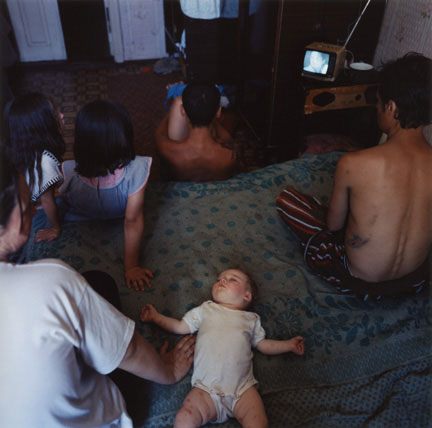
Watching TV, Odessa, 2002
"Oh look — Maria is a beautiful healthy baby. She is HIV-negative," said Ira while holding her baby and smiling, sweat glistening off her forehead. This was the first thing Ira said to me after a quick hello and hug. Moments earlier I had knocked on the door unannounced, ten months to the day after Maria's birth. Ira told me Maria was healthy. I, however, had doubts, especially after Ira told me about how Maria was in a coma several weeks earlier and how she nursed her back to health at home.
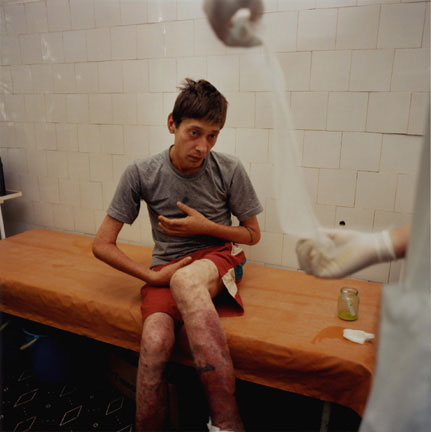
Seriozha, In Patient AIDS hospital, Odessa, Ukraine 2001
"Several weeks ago I came to check myself into the AIDS hospital and the nurse told me that there were no open beds, but if I was lucky, someone might die over night and space would be made available."

A 31-year old man who died due to complications with TB and AIDS, Odessa State Tuberculosis Hospital, Odessa, 2002
While enduring the intense Ukrainian summer heat and waiting to meet with the head doctor at the Odessa City Tuberculosis Hospital, I was busy trying to explain my intentions to several doctors and nurses who were questioning why a foreigner with a camera and a notebook was visiting their hospital. After several minutes, the conversation became more heated, with discussion quickly turning to debate. Through a window I saw two men carrying a long thin stretcher. An old brown blanket partially covered what was left of an emaciated cadaver. The head bounced from left to right to the rhythm of each step of the men as if slowly, quietly, and repeatedly attempting to say no, no, no...
This was not the first time I had witnessed such a scene in Ukraine. It was certainly not the last. Several hours later I was granted access to make photographs and conduct interviews in the hospital. A nurse escorted me to a room where I saw the body of a 31-year-old man who had both full-blown AIDS and TB. His gray lifeless skin clung to his bones. He had died only minutes earlier, yet it looked as though he had been dead for days.
As I lifted the camera to my eye, I heard a friend of the man who died, crying nearby. At this moment the nurse began yelling, "Look, don't you see, they do it to themselves; they do it to themselves. You tell the world! You tell them!" I was angry and did not understand why this woman showed no compassion or consideration for the grieving man who also was a very sick patient. I made two exposures and left the hospital shortly thereafter unnerved, more by the attitude of the nurse than by anything else. My idea of searching for faith in the face of illness was shattered. I found none there.
Lena shooting up, Mykolaiv, Ukraine 2001

Masha Undergoes Therapy for TB, Kherson State Children's Tuberculosis Hospital, Kherson, 2002
all images © Joseph Sywenkyj, courtesy of the artist