
Detail of silk-screened poster for PAD/D's anti-gentrification exhibition Not For Sale, 1984.(The guerilla art gallery "Discount Salon": is on the upper left side.)
"Pure repetition, were it to change neither thing nor sign, carries with it an unlimited power of perversion and subversion." - Ellipsis, Jacques Derrida 1
Snip, Snip…Bang, Bang: Political Art, Reloaded
by Gregory Sholette
The starkly rendered silhouette of a hydra-headed, real-estate speculator is glued obliquely to the red brick wall on the corner of First Avenue and 9th Street. Several few feet away a wheat-paste flyer announces "Reaganomic Galleries," spleenishly linking so-called trickle down economics ––that first, rudimentary attempt at neo-liberal spin –– with the ersatz Bohemianism of the East Village art scene.
It was the spring of 1984. The wall belonged to PS122, a former public school
turned not-for-profit venue best known for showcasing the emerging genre of
performance art. Unbeknownst to its staff, PS122's facade was transformed
overnight into the Discount Salon, one of four "guerilla art" galleries
christened with Krylon spray paint monikers that lampooned the flood of commercial
dealers opening shop across The Lower East Side. The other three pseudo-galleries
included The Leona Helmsley Gallery at the base off the then, derelict
Christa Dora Building, Another Gallery at 5th and Second Avenue,
and most prophetically the Guggenheim Downtown at the northwest corner
of Tompkins Square Park. In reality, these "galleries" were a quartet
of scruffy, graffiti-covered walls, temporarily commandeered by a group of
interventionist artists seeking to provoke a public debate about gentrification
and the political economy of the1980s art world. Not For Sale: A Project
Against Displacement (NFS), had grown out of a Marxist-oriented reading
group associated with Political Art Documentation and Distribution, or PAD/D,
a NYC collective active between 1980 and 1986. NFS officially opened in April
at the Guggenheim Downtown. Passersby were greeted with an patchwork
of wheat-pasted posters extolling squatted buildings, denouncing the free
market policies of Mayor Koch, and above all seeking to raise the consciousness
of young artists who were unwittingly, or simply indifferently, contributing
to the destabilization of the most culturally diverse, working class neighborhood
in Manhattan.
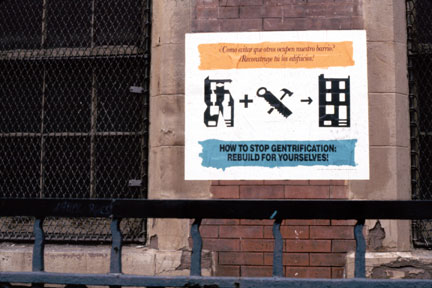
PAD/D's "Discount Salon," outside PS122, 1984. Silk-Screened poster by Michael Corris and Mary Garvin.
A mere four years later the Museum of Modern Art opened a comprehensive exhibition of post-war graphic art organized by curator Deborah Wye entitled, Committed To Print . It contained hundreds of politically-engaged works on paper, many of which were first produced as public interventions including PAD/D's anti-gentrification project, Not For Sale. It had taken less than half a decade in other words for this activist work to be collected, cataloged, and displayed within one of the most powerful, cultural institutions on earth. In point of fact, the MoMA library was in the process of procuring PAD/D's archive documenting several decades of art activism at the time of the show. It was a timely acquisition that coincided with a broader, art world sea-change in which an increasing number of artists were experimenting with political subject matter, even with social activism. By 1988, however, PAD/D was already disbanded, the New Left that once inspired it was in shambles, and the gentrification juggernaut was sweeping across The Lower East Side, as well as Hell's Kitchen where the legendary Times Square Show was staged in 1980. PS 122 remained intact, but like all not-for-profits it would soon face unprecedented financial challenges thanks to the comprehensive privatization of state functions taking place in Washington.2
What can be said about the art activism of the 1980s is that it tugged at mainstream art discourse, eventually stretching it some like warm taffy so that by the end of the decade the art world grudgingly admitted culture had a basis in social experience.3 Nevertheless, the initial response was to approach "political art," a label no one who took cultural politics seriously found useful, as if it were a novelty. As if socially-engaged art had not been made throughout the century, even during the abstract expressionist years. Eventually, museums bagged and tagged a limited number of socially critical artworks. It was, however, a selective assimilation that favored politically ambiguous work over the directly interventionist. Meanwhile, those collectives that had been instrumental in forcing-open the question of art and politics ––PAD/D, Group Material, the Art Workers Coalition, Artists Meeting for Cultural Change, The Guerilla Art Action Group, Paper Tiger, SPARC, Carnival Knowledge–– were unceremoniously submerged, partially or wholly, beneath the waves of normative art history. The record of their activities now exists within a shadow archive brimming with other examples of anonymous histories, collectivist production, and unrecognized modes of creativity. It is the gravitational pull of the hidden archive that concerns us here.
Theorist Giorgio Agamben describes the archive as, "the
mass of the non-semantic inscribed in every meaningful discourse as a function
of enunciation; it is the dark margin encircling and limiting every concrete
act of speech."4
The invisible presence of this ghostly periphery is what makes it possible
to even ask the question posed by the artwurl.org editors: "should activist
practices be exhibited in art institutions at all?" Which inexorably
raises more questions. Smart questions, that bend back against institutional
norms to ask: "Is there even such a thing as "activist curating"?"
Is it possible to create,
"An "active" exhibition space – one that is capable of
working in sync with these [interventionist] projects and explicit in its
attempt to affect a larger social fabric?"
The phantom archive's off-stage presence not only opens up this investigation,
but its elliptical return also constitutes, paradoxically, the very ground
from which to imagine a radical transformation of institutional power. By
way of repetition something is undone.
"Repeated, the same line is no longer exactly the same, the ring no longer
has exactly the same center, the origin has played." 5
Undoubtedly, the center is in play today. Again.
It starts like this. The return of a real, repressed not because its content
was necessarily so traumatic, but because it directs our attention towards
an ellipsis within the historical record where none is supposed to be. The
gatekeepers of the artistic canon eye the detour with trepidation.6 We however,
recognize that interventionist art, politically motivated art, collectivized
art is more than just another artistic genre, that its genealogy is more than
a collection of curious anomalies useful for sprucing up the same old art
historical canon. The phantom archive encircles mainstream institutions, invisibly
altering them not unlike the way cosmic dark matter prods the path of planets,
stars and galaxies. Often handed-down directly from activist to activist,
interventionist to interventionist, this counter-history reveals attempt after
attempt to re-imagine, and re-socialize, the entire practice of art from the
bottom up. Consider the following illustrations.
In the late 1920s and 1930s the John Reed Clubs (JRC) were cultural centers
that belonged to a parallel network of working class institutions that also
included cooperative apartments, socialist cafeterias, sports teams and holiday
camps. Along with art exhibitions, the JRC's organized educational programs,
film screenings, theater and poetry performances. Tirelessly debating the
political function of art, some of which was published in the pages of the
journal New Masses, the clubs also provided material support for
striking workers. (Imagine a contemporary art institution actively supporting
the recent NYC transit strike!)
Several artists' collectives in the mid-1960s sought to transform or redirect
institutional power by adopting the tactics of labor and civil rights activists
within the art world. The Art Workers Coalition (AWC), together with the Black
Emergency Cultural Coalition, Guerilla Art Action Group, and the Ad Hoc Women's
Committee walked picket lines, disrupted board meetings, protested censorship,
proposed that artists go on strike, and agitated for minority representation
inside the halls of major, New York City museums. According to Lucy Lippard
one group of art-activists inspired by AWC even developed plans to pressure
major museum's into lending out their collection to local, community-based
exhibition spaces. 7

Art Workers Coalition at the Guggenheim Museum protesting cancellation of
Hans Haacke's exhibition in 1971 and AWC inspired "fair trade" contract
for living artists, circa 1969 and
In the late 1970s a group of "Nuyorican" activists known collectively
as Charas seized an abandoned school building on the east side of Tompkins
Square Park and turned it into a local cultural center known as El Boho.
Inspired by this action a group of Anglo artists broke and entered a city-owned
building several blocks south on Delancey Street where they set up a make-shift
exhibition entitled the Real Estate Show. Out of this intervention emerged
ABC No Rio, an alternative, cultural institution that has been a home to graffiti
artists, comic book collectives, punk bands, political activists and community
residents for the past twenty-five years.

Sarah Safford of Carnival Knowledge tap dances safe sex tips for teens, 1981.
All throughout the 1980s artists sought to create autonomous institutional structures. The artists' collective Group Material called upon the art world to democratize its institutional practices, while the feminist art collective Carnival Knowledge used the vernacular of circus sideshows to stage spectacular, public projects promoting sexual and reproductive freedom. PAD/D even tried to construct an alternative, progressive art network resembling those of the 1930s. By the middle of the decade interventionist campaigns were launched against art world bigotry by the newly founded Guerilla Girls, and the group Gran Fury unleashed a range of interventions, performances, street graphics, and media tactics demanding government action against the AIDS epidemic.
During the following decade, one collective in particular focused its work on the phantom archive itself. In 1992, 1994, and 1998 REPOhistory installed temporary street signs informing passersby about the little-known history of working class, minority, feminist, and gay New Yorkers. The group's revisionist mapping projects took place well outside the parameters of the art world, simultaneously challenging the privatization of urban space while blurring the boundaries between public art, historic preservation, and political activism.
And in the past few years a series of urban, interventionist projects informally labeled Department of Space and Land Reclamation (DSLR) have invited urban gardeners, snake-charmers, pie-throwers, monkey-wrenchers, and artists to temporarily appropriate public spaces in Chicago (2001), San Francisco (2003), and Los Angeles (2004). Notably, DSLR's institutional structures exit only as long as needed, which is as long as it takes to organize and document any given campaign.

DSLR Logo for the San Francisco campaign
Makeshift institutions, radical art clubs, direct political action, labor strikes and even snake-charmers and pie-throwers? Artists who organize and organizers who make art, alternative spaces that are transformed into mock art galleries, curators and artists working together collectively, or who happily serve as conduits for moving material support to activists, unions, and interventionists situated on the far periphery of the art world? It does seem that the only feature these phenomenon share besides a mutual "outsider" status is a cavernous indeterminacy that goes well beyond the interdisciplinary frolic of contemporary gallery art. Theorist Stephen Wright describes the interventionist as an ontological secret agent who is forced to don multiple identities: artist/activist, theorist/practitioner, participant/viewer, organizer/organized.8 No doubt the interventionist curator will find such ontological prevarication indispensable. No doubt this same existential incertitude will also return to haunt them and their careers.
Standing before the increasingly delimited horizon of global capital I can think of nothing for a curatorial practice or an institutional venue to do, no matter how theoretically astute or politically committed they may be, that will effectively intervene within the broader social sphere. Nothing that is, except perhaps to sacrifice the one commodity still valued by enterprise culture: occupational identity. For despite postmodern promises of authorial annihilation and declarations of radical hybridization, art world success still rests squarely upon the certifiable display of accumulated cultural capital. Just think of the way the Curriculum Vitae, with its titles and offices and exhibition venues, or the way one's reliable signature, serve as letters of transit. Instruments of authenticity that provide, or deny, passage throughout the system's checkpoints, from informal introductions at openings, to job applications, to publication opportunities. Under such circumstances in other words, who would choose to build an art career upon the shoals of ontological incertitude? Who would take a chance their papers would be found out of order or worse, to be counterfeit? Except perhaps the double agent?

The NFS poster on the streets of New York’s Lower East Side, 1984.
Footnotes:
1. "Ellipsis," from the book Writing and Difference by Jacques
Derrida, (University of Chicago Press, Routledge & Kegan Paul Ltd, London
and Henley: 1978), p 297.
2. The restoration of laissez-faire economic values was accompanied by blistering
condemnations directed at certain artists, a phenomenon the art world reduced
to a war over cultural values, an interpretation that political conservatives
were only too happy to propagate.
3. Of course modernism's formalist firewall was breached on several fronts
simultaneously. Clemet Greenberg's theoretical franchise was usurped by Feminist,
Marxist, and Post-Structuralist thinkers, while many younger artists gravitated
towards a gritty punk aesthetic that, together with the new wave of politicized
collectivism, abandoned post-war conventions, including those of the established
Left.
4.Giorgio Agamben, Remnants of Auschwitz. The Witness and the Archive,
p 144.
5. Derrida, Op cit.
6. In this sense the reified, re-creation of the 1966 "Peace Tower"
for the 2006 Whitney Biennial is exactly the type of repetition we will be
seeing more and more of over the next few years as the art world attempts
to reign-in the potentially destabilizing energy of interventionist creativity
taking place outside its parameters. (It worth noting that like so many Hollywood
remakes the 2006 "Peace Tower" casts the senior Mark di Suvero from
the original production together with younger co-star Rirkrit Tiravanija,
buff and beefy with plenty of art market muscle.)
7. Ludy R. Lippard "Biting the Hand:
Artists and Museums in New York since 1969," in Alternative Art New
York: 1965-1985, edited by Julie Ault (University of Minnesota Press,
2002), pp 79-120.
8. Stephen Wright, unpublished paper presented at the Townhouse Gallery, Cairo
Egypt, December 13, 2005.
download a pdf version of this text here (1.7MB)
©Gregory Sholette, 2006
Gregory Sholette is a NYC based artist, writer and a co-founder of the artist collectives REPOhistory (1989-2000), and PAD/D, Political Art Documentation and Distribution (1980-1986). Recent exhibitions include A Knock At The Door at The Cooper Union NYC and film screening Anthology Film Archives. His work has appeared at the MoMA NYC, Dia Art Foundation, New Langton Arts, and Exit art. Sholette is co-editor with Nato Thompson of The Interventionists: A Users Manual for the Creative Disruption of Everyday Life (MIT: 2004 & 2005); and Collectivism After Modernism co-edited with Blake Stimson (University of Minnesota Press, 2006). He teaches classes in critical theory at New York University.