WORKING (Round 7)
A conversation between Andrea Geyer, Sharon
Hayes, Ashley Hunt, Maryam
Jafri, Kara Lynch, Ulrike Müller, Valerie Tevere, David Thorne and Alex
Villar.
As an artist I have always understood
my work as a combination of different practices. One of them is the ongoing
discourse that I have with my colleagues around working, teaching, politics,
theory and of course the challenges of every day living. By its nature this
discourse is rarely public. Being invited by Carlos Motta, to contribute to
artwurl.org in form of an interview, I suggested that instead of generating
a new conversation, I would invite some of my colleagues to formalize some
of the already existing dialogues that we have and have had over the years
to be contributed to the magazine. What brings this group of artists together,
I think, is a shared agency in our work that I hope will become visible in
some of its layers over the course of this conversation. Formally we decided
to each ask one question which will be answered by everybody else. We will
publish the questions in succession over the course of the next issues of
artwurl.org. I would like to thank you Carlos Motta for his invitation giving
us the opportunity to develop this dialogue. -Andrea Geyer
Valerie Tevere: Recently, in a discussion following a presentation
at 16 Beaver, questions came up regarding aesthetic representation and other
manifestations of protest. There are various levels of critique and articulation
(I know most of us have worked with and through ideas of dissent and/or representations
of such). I am interested in the task of the represented and her/his relation
to the situation/group/individual represented.
Concurrently, I would like to discuss the fashionable or parodic trend of
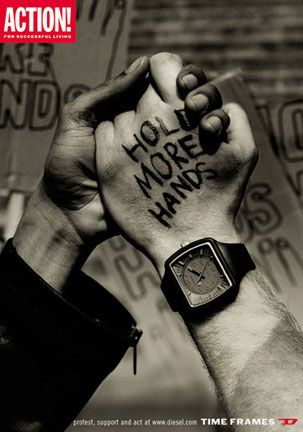
protest imagery within the marketplace—both the art and commercial worlds.
What is the nature of this trend? How does it speak of our present political
moment? And through its abundance, how might it affect more critically produced
work? What about civic engagement and efficacy?
**Postscript:
The comment of "fashionable or parodic trend of protest imagery in both
art and commercial realms" was not intended to level all works in this
terrain as fashion or parody, but to speak of the trend (happening alongside
critically important work), which I find lacks a certain rigor or evaluation.
If it reads otherwise, here's my addendum.
David Thorne: This is complicated terrain. I will touch only
on an aspect I am most interested in, which has to do with recollections of
protest past. There are current works—and artists making works, authors
writing texts, and so on—that are neither parodic nor fashionable, but
part of an effort to evaluate and reevaluate certain notions and practices
of left, oppositional, critical politics during a present moment in which
the past persists, inspires, fails, does not hold up, informs, and in a persistent
way demands our reconsideration and reevaluation, and pushes us to think ahead.
Sometimes these reconsiderations happen in artistic production through restagings
or reenactments, both interesting and uninteresting. As much as there may
be a trend developing in terms of artistic practice around the restaging and/or
the reenactment, it seems at the same time difficult to generalize as to its
goodness or badness. And however much we may want to read this sort of work
as symptomatic of loss, or perhaps even of political confusion, it seems important
to pay attention and not lapse into either nostalgia for the supposed clarity
of these or those old days, or despair in the face of the sort of cynical
triumphalism that finds its expression, among other places, in advertising
that mockingly and with painful cuteness takes up the banner of protest, or
another despair in the face of a present that, for all its repulsive contradictions,
seems increasingly difficult to resist. Perhaps this paying attention means
recollecting with a certain vigilance (in particular, attention to what Valerie
marks as the relationship between representer and represented), without expectation
that the past will provide answers, or that it has to be answered to, and
without the sort of glibness through which one thinks, "I can inhabit
this form without attachment or sentiment or political consequence because
it is dead." This suggestion of vigilance resonates with someone else's
suggestion (Walter Benjamin—or as Ashley refers to him, "The WB"—Foucault,
Nietzsche?) that one's task is to make the past an outrage to the present,
which I understand also to mean to make the present an outrage to the present.

February 2006, corner of Broadway & White St., NYC
Alex Villar: I would agree that there has been a generalization or, at least, a growing rate of absorption of resistant imagery by the communication-entertainment apparatus, which, of course, encompasses a significant portion of unreflected production that finds its way into the art field. I think that Valerie draws due attention to the potential problems generated by an opportunistic use of meaningful protest imagery. And, as she has indicated, this assessment does not preclude the need for the type of critical reflection that is so eloquently articulated by David. The question, then, is what to do about the degree of distinction that separates the "opportunistic" from the "necessary" in the representational spectrum. I am just not very certain that "effectiveness" should be the decisive qualifier here, as it is possibly a divisive concept. Resistance is something that operates from the standpoint of the weaker side; its power derives from the potentiality of figuring in a coalition of forces. It shouldn’t be subjected to measure, especially not to a subtractive operation. I think we should dissociate "engagement" from "efficacy." Surely, we need results—but let that be a goal, not a measurable venture. Sometimes I wonder if it is not this impulse to quantify efforts that stands in the way of a closer approximation between "civic engagement" and "vigilance." Obviously, those are very distinct operations that demand diverse means of assessment, and we know that subjecting them to the same criteria of evaluation is tantamount to depriving each of their very specific ways of contributing. The task, then, as I see it, should not be to subject both terms to a homogenous examination but to collate their heterogeneous contribution as a consubstantial text. This gesture might not dissipate the cloudiness created by opportunistic manipulations, but by strengthening a resistant constellation, it might eventually render those maneuvers inoperative.
Andrea Geyer: For myself, I have also worked in my recent works with images of protest, and I think it is very important to understand that protest and its representation have had very different meanings over the course of the last 50 or so years. The place from which people decide to go on the street, and what that act creates in terms of a space of political action, has shifted. It seems as if the body attached to public speech has become an unusual site. Furthermore, more than once has it been discussed that the large protests in the recent years in New York, which I witnessed, as well as those in the rest of the country, are presumed not to be relevant because they are not represented by the media and therefore not impacting a large constituency—a speech unheard, a speech act not completed. This is different from maybe 30 years ago, when it seemed that acts of protest had bodies and also were relevant news. Now that the media, more than ever, is guided by corporate interests, protests are not news, even if 30,000 people find the reason to mark their voice publicly. I do believe that represented or not, the getting together in the vanishing public space of large cities is an important action that has an impact on people participating and that it will have consequences. But that is a different issue.
To return to my first point. The use of images of these protests in the context of contemporary art is hard for me to generalize. There is work that uses the image of protest or the content of signs that does not more than picture and then through a simple aesthetic shift objectify the protest (comodification then comes next . . .). But there is work that does contextualize the image that it produces/reproduces and challenge notions of the individual subject speaking publicly and use these images with the idea of producing meaning in relation to the representation/image of protest/the protester. In the mediatized landscape of this century, protest seems an archaic form, seemingly detached from the power it had about 35 years ago. Public speech seems to be recognized only in blogs on the Internet, in chat rooms. What I find relevant is to understand public speech attached to a body putting herself into the public and marking an opinion/site of individual agency within it. That was and is a pretty radical gesture, especially in a society where the body has been marked as an uncomfortable task to shape, form, and render into a corporate ideal.
In a more general sense, I would say that as an artist one has a choice (drawing the trajectory all the way back to WB) to produce aesthetic products that conceal their political nature, allowing that they fit effortlessly into the functioning of the dominant order (in terms of market or ideology), or to render apparent the interrelationships that made up that order, and thus, to oppose it. Where Benjamin was marking the danger in the separation of form and content 70 years ago, it still applies today. As artists we use representations and have to challenge these modes of production in our own work. The images we use, here the ones of protest, reveal a meaning that can be worked with. The desire from the side of market/trend that Valerie invokes reveals for me a discomfort with politics in general, and then by the work it seems to champion (that uses protest images rather as a pop gesture), it reveals an even larger discomfort to actually deal with these politics all the way into one’s own field of production.
Ashley Hunt: In preparation for a recent show titled "Capital (It Fails Us Now)," the curator asked us (the participants) to read Guattari's essay "Capital as the Integral of Power Formations" (Soft Subversions, Semiotext(e), 1996). Without too much detail, I'll summarize one argument the essay presents: that capital has a semiotizing effect. This I understand as a resignifying, but more so as a (de/re)territorialization; not only with respect to the meanings of representations, but also to the way representations come to participate symbolically in the ordering and arrangements of power between things. I think of this especially around the question of protest imagery and the marketplace and wonder if "semiotizing" isn't a better framework than cooptation or absorption, or strict measures of efficacy.
Here's a highly subjective and suspect chronology: 1) 1986: Nike runs a TV commercial advertising shoes set entirely to the Beatles song "Revolution." Around this same time, a boy at my high school who twenty years earlier might have invested his "revolutionary" in a raised power fist, has his Adidases manhandled off his feet outside a Beastie Boys concert. 2) 1998: From my bike in midtown Manhattan, I photograph a billboard advertising Earthlink. The ad mimics 1920s labor iconography, foregrounding a lone figure, power fist raised, but his face is erased. The slogan beneath him reads, "The Power of Anonymity." 3) 2000: I'm working for a Web company (a particularly capitalist one) that produces an online community named "Fortune City." This "city's" iconography is a haphazard mishmash of constructivist and socialist architectural aesthetics, and the city is advertised in the Village Voice with copies of paintings that mark the emergence of Western, liberal democracy (e.g., Liberty Leading the People). 4) 2004: My partner cuts out a designer clothing ad: Naomi Campbell as a 21st-century Huey Newton, seated in the same iconic wicker chair but without the rifle in one hand (the present) and spear in the other (one assumes the "past"). Just a raised fist with an ambivalent look into the camera, which I read as cynical, and with a much fancier, rabbit-fur-lined leather jacket than was Newton's. The image seems to signify a few possible reads: a strong black woman on what was previously the man's throne; high fashion that points to a renewed, affluent black business class; or through the image's marks of the contemporary, the projection of some optimism for "look how far we've come." But the melancholic look on Campbell's face might give the lie to such optimism, as if she were herself uncomfortable with the discontinuity between Newton's gesture of struggle on the one hand, and on the other, using a symbol of hope, struggle, and power to sell the status afforded by a fancy fur jacket. 5) 2006: Howard Stern's radio program has a new billboard on the roads: The logo is, yes, a power fist. And, now using the FCC to shut down pirate radio stations broadcasting Stern's cable radio show, the slogan reads, "Let Freedom Ring. And let it be rung by a stripper."

What I'm trying to point to, however superficially, is not just a cynical or arrogant appropriation of symbols and modes of Left resistance by capitalism, nor these symbols' "first tragedy then farce" status, nor the disguising of their "true" meaning. Rather, I'm recalling instances where I’ve witnessed symbols of strength and resistance equated to the strength of capital and the status it offers—mapping, for example, one's desire for "freedom" onto relations or acts productive of capital and the power that it orders; where subjects' desire and energy for freedom, liberty, equality, rebellion, and so forth find their expression and orientation along trajectories that help order and reproduce the conditions for capital's reproduction. (Importantly, I do not think this means that their desire is what capital or power would want it to be deterministically, but clearly it has significant enough influence on how that desire finds expression that many can hardly tell the difference.)
Perhaps a better strategy than my anecdotes would be to see how, since the end of the Cold War, without a hegemonic discourse like socialism to hold the concepts of freedom, power, and democracy outside the space of capital (or at least outside the economic), these concepts have been claimed as the sole provenance of free market capitalism. Here we see capital as having semiotized the political and private domains of life into its own symbolic—subordinated to market rationality and codified as economic; where economic power and freedom become indistinguishable from political power and freedom; where aspects of private life are bought, sold, yet wholly unprotected except for where they are economically measurable (in terms of property and business rights).
Might this be the context for the proliferation of protest artwork today? Not merely a case where lots and lots of artists are participating in protest and "getting political," but one where the modes, habits, and positions of protest we call up are inscribed already within an altered field of significance and order, where they no longer mean what we assume them to mean; where they lack the force or influence history ascribes to them and remain disoriented gestures, leaving us disoriented ourselves. This seems accurate when we look to artists taking up aspects of protest and resistance as objects of reflection, enigma, and paradox, as slippery signifiers rather than transparent claims and demands. I think of Sharon's work, for example, where instances of political speech are not treated as self-evident but are de-centered and estranged, pointing us to a consideration of the larger field in which they are given meaning and the status of political speech. I can think of anyone else in this discussion, in fact, and most of his or her work does not pose direct claims but opens up the field in which such claims are even possible, visible, or legible.
So rather than thinking about protest in artworks from a strict art world criteria (I've seen this before, isn't this clichéd? Or, is this art?), or a strict political criteria of efficacy, I'm most interested when such work gives us the space to reflect upon our expressions and habits, our positions and vocabularies as they are reflected back to us, inscribed, re-articulated, and territorialized within this larger semiotic field, and not with the intention of "making art" per se, but so we might see how they function, to reorient ourselves if we want, or indeed, to come to know what in today's world something like efficacy even means.

Found on www.tampatantrum.com
Kara Lynch: I'm out of order—or not. I am struck by this sentence in Andrea's response: "What I find relevant is to understand public speech attached to a body putting herself into the public and marking an opinion/site of individual agency within it. That was and is a pretty radical gesture, especially in a society where the body has been marked as an uncomfortable task to shape, form, and render into a corporate ideal."
The body. A brain with a body attached to it. Both in the same place at the same time—marking a moment, creating a speech act—acting. This is important. I guess then the question for artists comes at the point of representation. How will we deal with the distance that is intrinsic to this next level of meaning. Do we erase the body entirely? Or do we implicate it in the work? I do not mean literally are there figures depicted in the art object, but whether or not the body/brain dynamic is totally suppressed, ignored, and forgotten or whether it is ever present in the actual form and content of the work. For me this is critical. It is a critical stance to involve these questions of body/brain contest and conflict in this 21st Century Fox post-shock + awe moment.
Protest and Its Representation. I'm not sure what I think about the work that people have mentioned. At the same time I don't think we can just say that images of protest are obsolete. Maybe it's strategies of protest and demonstrations that have hit a wall. I think there is more work that representation could do. I asked students recently if they had ever actually seen images of any of the marches on Washington. Only one had, and it was the most recent antiwar protest. Maybe I'm naive to think that it would make a difference for them to actually see these images—somehow I think that they might get the idea that you could actually DO something that has meaning, even if marching on the capital is not that something any more. Anyway, I was distressed that many of these young people in their late teens and early 20s are sure they know what that looks like, but they've never actually seen a march on Washington live or recorded. And then the question also arises, "What does that FEEL like?" And for me the real work is expressing and understanding the relationship between the action, the feeling—both physical and emotional, and its representation.
On another note, I was in Beirut this November for a forum called
Homeworks III. There was a really provocative performance by Rabih Mroue entitled
"Who's Afraid of Representation?" The piece was created for a Beiruti
and international audience (there was simultaneous English text translation—like
at the opera), and pitted the descriptions of endurance performance artists,
predominantly from the '70s to the present, lives and works told in the first
person by an actress behind a screen against an anecdotal retelling of the
events that led up to a Lebanese man's recent breakdown and killing spree,
also told in the first person by an actor. You have the sense that this story
has been pieced together through newspaper clippings. The structure of the
piece is that the two performers are at a table in one corner of the stage.
The man seated with his profile to the audience has a timer. The woman standing
facing the audience holds a book. She closes her eyes, opens the book to a
random page, blurts out a name—Chris Burden, let's say—and a number—52.
The man sets the timer, she walks center stage behind a giant screen and faces
us; he says "Go" and she, Chris Burden, tells us about his life
and work in 52 seconds. The man at the table says "Stop" and she
returns to the table.
Occasionally she opens the book up to a picture. She says "Picture"
and walks behind the screen then toward a video camera at the back of the
stage, which has provided the live feed of her performance the entire time.
She brings the image up close to the camera so that it fills the screen. At
this time, the man stands and walks to center stage in front of the screen
and tells parts of his story. When the both return to the table it is business
as usual.
There are more details to the ending, etc., but I describe this performance this much because it is relevant that the recounting of these individual artists putting their bodies on the line for the sake of art, or rather representation, at first seems indulgent, ridiculous, humorous, Western next to the Lebanese experience of civil war that coincides with much of the performance work described. Occasionally in the descriptions there are historical references to what was happening in Lebanon at the time. As the piece progresses, both contexts come into question and meanings shift—we begin to think that maybe, just maybe, a piece made in '70s where the audience is given permission to do whatever they want to the artist with the household objects she has provided might actually be a protest against escalating violence perpetrated by the U.S. inside and outside its borders. We also by the end consider these performances in light of self-preservation and self-destruction and think about whether in the end all we have to speak with is our own body—like the man who kills his workmates and then himself on an otherwise ordinary day. All the while this information is mediated through cameras and screens and actors and the stage. A few things to note: The audience laughed a lot, especially at the descriptions of the performances that were the most grotesque and violent; the piece showed three times during the week of the forum—all were full to capacity, the first on opening night, and on the second there were rumors that it had been censored and the third was a compromise between the censors and the artist. My understanding was that the censors took issue with many of the profanity in Arabic and mentions of Hezbollah. The censors only cared about the Arabic version of the performance and did nothing to change the English translations. This work shifted a lot of my own ideas about performance and representation and toppled some of my preconceived ideas about what it is to live in a violent place where the precedent of people’s standard of living is not "peace."

Sharon Hayes: Just a few short thoughts that bounce off the various lines of discussion happening already.
1. I must say to begin that I'm always very suspicious of the notion or category of the "trend." While I understand Valerie's invocation of it in her question, I think that it has often been used to dismiss what I might say are productive repetitions that mark out a field of debate. I have noticed that there is a lot of artwork and that there are a lot of advertisements that take up the image or representation of protest. I notice that in part because I am drawn to images of protest. I hardly look twice at a billboard of a person smoking or a shiny black car; similarly, I usually need some outside encouragement to give more than a glance at a figurative painting of art world luminaries. But pass a picture of Naomi Campbell posing as Huey Newton by me and I'm engaged, we're engaged, we're writing about it and debating it. I say this because I think it has to be said that Valerie marks this as a trend (verbalizing what we've all noticed and perhaps articulated using different language many times ourselves) because of our own psychic investment in this terrain. Perhaps I am so invested because, as Kara points out, these images are deeply and directly connected to my material experiences and also to my fulfilled and unfulfilled desires, as a political person.
2. Shifting the terms from "trend" to "field of debate," the numerous invocations or enunciations or representations of resistance are no less interesting because of their volume or their opportunism or their claim to power. I think Ashley is right that in this field of debate there are various struggles going on. My engagement, in my work, with the representation of protest is firmly situated within this space (or these spaces) of contestation.
3. I am making work that takes up the figure of the protester. I will describe it because it seems relevant to the discussion (as it was a talk about this work that Valerie is in part referring to) and also because it contextualizes my position to other work that takes up protest as its content.
In this work, which I began in November, I stand on the street for an hour with a protest sign. So far I have done this as one series (nine actions, nine days) in New York City. The signs are a collection of slogans from past protests: "Ratify the ERA Now!," "Who Approved the War in Vietnam?," "I Am a Man,” among others, and also some that are constructed to hint to a future moment: "Nothing Will Be As Before." Then I invite an audience to come and document these actions. What is produced, materially speaking, is an excess of images of me on the street with a sign. I look like a protestor, but as Ashley pointed out, it is very much not a protest. The anachronism or conditionality of the address made by the sign confuses the usually direct claim of a protester. There are a lot of things I don’t know yet about this work and what I am particularly or precisely interested in, but what has been important to me is to put myself in the space of the enactment. I do this because on one hand, there is something that I think I need to know from that position of the figure with the sign, the protesting figure, that I wouldn't be able to find out by asking someone else to do the action. But it is also important for me that this figure is fully embodied. By that I mean that it's not a character or an actor or a performer, even, but that it's a body that is invested in the act. I'm not interested in creating an image of protest but in thinking through the relation between the speech act of protest and the image of the act.
4. In talking about this work in public, I often point to a thin line that I feel I have to negotiate. I suppose by that I've meant the line that separates out what I am interested in asking in my work from artwork, to which I think Valerie was in part referring, that aestheticizes a given political event and thus drains it of its meaning. Sam Durant has made colored light boxes of various protest slogans. His work, while using politics and political resistance as content referents, is not actually about protest or resistance. His work is primarily about art. What our discussion in part illuminates for me, is that I’m no longer sure this line we are negotiating is so thin.
All images selected and compiled by Valerie Tevere
© Working 2006
CVs and weblinks:
Valerie Tevere - Driven by discursive practices,
Tevere's work has looked to the public
sphere as a condition and framework for inquiry and discourse. Recent projects
permeate
the urban environment as temporal public works and performances that rely
upon structured yet spontaneous encounters with city inhabitants. Tevere‚s
solo and collaborative projects have been exhibited internationally at venues
throughout North and South America and Europe. She was a fellow of the Whitney
Independent Study Program in 2000, a recipient of a Mellon Humanities fellowship
at the CUNY Graduate Center 2002/03, and, as part of the radio collaborative
neuroTransmitter, is currently in-residence at Eyebeam Atelier, NYC. www.neurotransmitter.fm
David Thorne lives and works in Los Angeles.
His recent work has addressed the conditions of so-called globalization; notions
of justice shot through with revenge; and memory practices in a moment of
excessive rememorations. Current projects include "The
Speculative Archive" (with Julia Meltzer); the ongoing series of photoworks,
"Men in the News" (1991-present); and "Boom!" a collaboration
with Oliver Ressler.
www.speculativearchive.org
Alex Villar lives and works in New York. His
work draws from interdisciplinary theoretical sources and employs video, installation
and photography. His individual and collaborative
projects are part of a long-term investigation and articulation of potential
spaces of dissent in the urban landscape that has often taken the form of
an exploration of negative spaces in architecture. His work has been exhibited
internationally, including at the Institute of International Visual Arts in
London, Museu de Arte Moderna in Sao Paulo, Paco Imperial in Rio de Janeiro,
Tommy Lund and Overgaden in Copenhagen, Contemporary Art Centre in Vilnius,
the Goteborg Konstmuseum in Sweden, Joanna Kamm in Berlin, Arsenal in Poland,
Lichthaus in Bremen and Halle für Kunst in Luneburg, Exit Art, Stux Gallery,
the Art Container and Dorsky Gallery in New York. He holds an MFA degree from
Hunter College and is a 2000 graduate of the Whitney ISP. In 2003, he received
a NYFA fellowship. www.de-tour.org
Andrea Geyer lives and works in New York. Her
work stresses the possibility of defining
complex fluid identities in opposition to mechanisms which attempt to form
and control
static collective identities. Big cities are recognized as sites for projected
images and
fantasies, places of diverse political, ethnic, religious and social realities,
integrating
relations between human beings and their surroundings. Her work has been exhibited
internationally, including the Whitney Museum of American Art, Serpentine
Gallery,
Secession, Manifesta4, PS1 Contemporary Art Center, Parlour Projects and White
Columns. She is a 2000 participant of the Whitney Independent Study Program.
In 2003 she received a NYFA fellowship as well as a IASPIS residency. She
is currently a resident at the Woolworth building LMCC space program. Over
the recent years she has been involved in various curatorial and organizational
projects among them Nomads and Residents, NewYork. www.andreageyer.info
Ashley Hunt is a Los Angeles based artist who
works primarily in video and multi-media.
His main project of the last five years has been the "Corrections Documentary
Project",
exploring the political economy and relations of U.S. prison expansion. ashleyhuntwork.net,
correctionsproject.com,
prisonmaps.com
Kara Lynch is a time-based artist stretching
her limits into space. Her work crisscrosses
media, but she will own performance as her discipline and point of departure.
Recent works include: 'Black Russians' 2001 117min documentary video; 'Mi
Companera' 2002 12min video; 'Xing Over' 2003 6hr performance/2.36min 3 channel
audio piece; 'Invisible: episode 03 meet me in Okemah, Ok circa 1911' 2003
7day audio/video installation. En exilio in La Jolla California, she retains
a post office box in Nueva York and a storage space in Western Massachusetts.
She is a gemini monkey born in the momentous year of 1968.
Sharon Hayes is an artist who employs conceptual
and methodological approaches
borrowed from practices such as theater, dance, anthropology and journalism.
In her most
recent work, she has been investigating the present political moment through
a critical
examination of various historic texts, including a speech form the 1968 democratical
convention in Chicago and the transcripts from the audio tapes made by Patti
Hearst and
the Symbionese Liberation Army in the 1970s. Her work has been shown in gallery
spaces
and theatrical venues including the New Museum of Contemporary Art, P.S.1
Contemporary Art Center, Andrew Kreps Gallery, Dance Theater Workshop, Performance
Space 122, and the WOW Cafe in New York City. Hayes was a 1999 MacDowell Colony
Fellow. She also received a 1999 New York Foundation for the Arts Fellowship
and a IASPIS residency in 2003. www.shaze.info
Maryam Jafri is a video artist based in New
York and Copenhagen. Her work centers on
performance, narrative and gender. Her work has been shown in numerous exhibitions
and screenings both in the US and aborad.