Interview Serkan Ozkaya
by Defne Ayas
Turkish artist Serkan Ozkaya reproduced a larger than life replica of Michelangelo�s David for the 9th International Istanbul Biennial. For this production, Ozkaya used a precise 3-D computer model and built the sculpture out of thousands of layers of foam and painted it gold. Tragically the piece collapsed during its installation on its pedestal at the exhibition site in Istanbul, and therefore has been withdrawn from the exhibition. What remained was a video and photo documentation, and questions. Defne Ayas exchanged emails with Ozkaya about David�s fall as it relates to his practice as an artist, the biennial, and life in general.
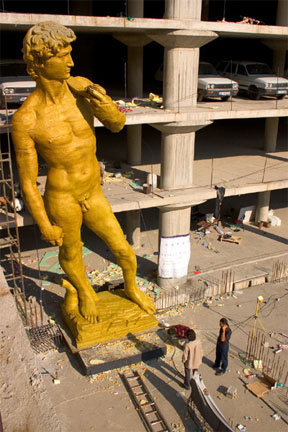
Serkan Ozkaya, David (inspired by Michelangelo)
Defne Ayas: How is David doing now? Healing?
Serkan Ozkaya: We'll start with the restoration soon and install the statue in an art space afterwards, an interior that is.
DA: You have sent email updates to your friends throughout the construction of the David. What were you envisioning as a response from the public, had the accident not occurred?
SO: I just wanted to share my enthusiasm throughout the journey. You know, I don't always produce work that is time-based. This time my emails and the Biennial office's press photos of the construction coincided. I think the project wasn't too hard to grasp even during its making. We built up clear expectations of what it would be. I'm still in the 'making-of' part; trying to find a way to restore it, therefore I'm not sure I can answer that question.
DA: I should have never replied back to one of your emails and said, "This is rocking!".
SO: You should have said, "That's a sound idea!".
DA: I know! How do you perceive David now?
SO: On the one hand, I managed to make what
I envisioned: A double sized, golden David inspired by Michelangelo. On the
other hand, people in Istanbul lost the chance entirely to bump into this
icon of classical beauty while walking on the street. That's the disastrous
part. People lost their presumed innocence, which would enable them to see
the statue for the first time and encounter it with their bodily perception
(see Kant's "First Moment of the Encounter with the Work of Art"
in “Kritik der Urteilskraft"").
This means when you bump into this enormous object of classic beauty, shining
like gold, you don't have time to place it intellectually at first. You'll see
it or rather confront it, as you would a car crash per se or thunder. This breaking
moment is utterly important. After this moment of brief ecstasy comes perception,
along with intellectual evaluation and placement. One asks, What is this? Where
do I know it from? Etc. Although the first moment inhabits many opportunities,
it's the moment where all the presumed politeness vanishes.
A few weeks ago I was at the airport, where people act measured and keep a certain
distance from each other. There's an artificial and precautious politeness in the air.
It's a place where there is some tension in the air, as if something could happen at
any time, such as a bomb, a plane crash, smuggling etc. Anyway, I was pushing one of
those metal carts carrying my luggage. Following a line of people I went onto this
automatic belt, which was on an incline. When I was supposed to exit, my cart was
stuck and I couldn't get out off of it. In the first instant I managed to keep a smile
on my face and so did everyone else around me. Then after we saw that other people with
their metal carts started to pile up behind me, came a very brief moment of sarcasm, a
certain awkward moment; after this moment we all forgot or by-passed our politeness and
tried to rescue ourselves and the goods. This moment of knowing that you are facing something
that you cannot ignore, underestimate, or cynically dismiss is the key.
DA: It must be frustrating for you that people could not experience this encounter with David first-hand.
SO: People saw my David on TV news and if erected one day, the viewer would hopefully say, "That's the statue I saw on TV." In that respect it already became an item of this land. It’s not Michelangelo's David, not even a copy of it, but 'the broken statue' of a Turkish artist at the Istanbul Biennial.
DA: Why did David really fall? Was it miscalculation, or lack of experience of the art handlers? What were your feelings during and after the Fall? Are you at a point, where you can abstract it now?
SO: According to Sureyyya Evren, my writer
friend, it fell because the Gods wanted it so. But I believe it was very lousy
planning and an un-professional technical job.
It is told that when the Large Glass broke even Duchamp said, "Now it's finished." When David collapsed and was broken, I said, "Now I'm finished!"
DA: Did you really think you were finished? You should maybe laboriously repair your work like him? Or fax another copy of David and start the process again? Is there any distinction left here, between the copy and the original for your David? Has there ever been one?
SO: I meant it as a joke but thinking of it,
it may have been the moment when life began imitating art. Or was it the other
way around? (I keep confusing the two.) Like Tower of Babel collapsing, or
statue of Lenin, or Saddam, this time an icon of beauty collapsed, imitating
history or the news.
The situation is more complicated than I thought. I was supposed to make a
copy of the original and my copy would have some qualities that would be superior
than in the original, which supposedly would turn my copy into an original
of its own. Now that copy is lost and I have nothing left but the original!
There are always future plans (e.g. repair it; make a new one – since
there's the computer model which can't practically get lost, or could it?)
but I'm too scared of jinx to talk about them.
DA: Fair enough. The mainstream audiences in Turkey are not familiar with the biennial at all, and it is only with the Fall of David that the program got some public attention, of course through media coverage. One can easily think that this was a conceptual accident- a situation designed to open up some channels for interaction. Have you observed any shockwaves following David's Fall in Istanbul?
SO: It certainly became an event. As for myself I have always liked stories, I like them even more when they aren’t true.
DA: Do you think this accident can be a trigger to change the kind of weak relationship between the art world and the press and the public in Turkey? Or this would be too ambitious to think?
SO: I doubt it.
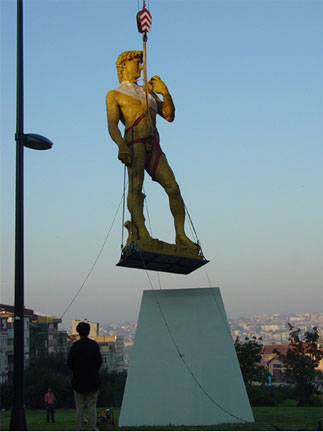
Serkan Ozkaya, David (inspired by Michelangelo)
DA: But people could refer to your work as something more familiar, whereas the biennial is still perceived as a foreign construct. I thought maybe this fall could provoke and catalyze a correspondence between the biennial and the mainstream. Weren't the biennial organizers after such a dialogue with the street, even though they did not curate the Fall per se?
SO: You're right in the way in which the fall
of the statue was spectacular. It was a spectacle for the society. After I
read some comments on it I started to prepare a text which would have been
something like "Picasso Speaks!" And my text would have ended with
a statement like "It was a grandiose failure!" had I decided to
write and finish it.
Maybe because of my own arrogance or ignorance or both, I tend to underestimate
the strategies of contemporary art as we call it, and many times I label works
of art as powerless. The making of a giant David probably attracted the public
and the art sections of the papers and magazines, and so would the erection
of the statue, although the fall attracted a wider public and media. That's
simply the disastrous character of the news. If there weren't any injuries,
the cameras never would have shown up.
But I hesitate to say that this is a breakthrough in the history of recent
art in terms of the attention it gets, since art rarely turns out to be so
real.
DA: How do you decipher the loop problem that art is not that real?
SO: I have almost always had 'fake' experiences; I was impressed by the books I read, by the music I listened to and by the stories and pictures of art works I could get a my hands on. I am Emma Bovary, so to speak. Although instead of trying to live those lives of those people I wanted to stage those lives and works of those people. I wanted to join the club but "I refuse to be a member of any club that accepts me as a member!" (G. Marx) I want to produce the works of art I have seen in books or have heard about. It's as simple as that. My whole drive isn't real; it's pure fiction or fantasy, make-believe as they say. It all gets more amusing once there's a way between reality and play. If you're able to draw the newspaper and publish it for one day, that would mean fiction became real and reality is made-by-hand. You can try it home.
DA: How do you then see the actual relationship between "reality-creators" and artists? Columnists, journalists, and writers have been the privileged to produce every-day culture before the 90s. Turkish artists (of the "contemporary art" stream) on the other hand have been operating pretty much in a similar fashion since the 80s in the sense that they respond to official discourses, and deal with the socio-political issues. Nevertheless, their articulation and production takes place in more conceptual ways, and in a highly latent import-export system. For me, it is interesting to ask this question to you, since you have been able to pass through that barrier with your projects that have reached many audiences, especially when you turned an actual newspaper into an artwork for a day during the past biennial…or now with the accident.
SO: The day my statue broke I wanted to check
the TV channels and see what they were saying about the incident. I barely
watch TV, and I was literally shocked when I turned the news on: The city
was living in was going straight to hell! Policemen were spraying tear gas
in the eyes of passers-by, demonstrators were trying to kill everyone they
could get a their hands on, buildings are were burning, hand-made bombs are
thrown on the streets etc. I felt like Tracy Emin when she replied to the
question, "How do you feel after your Tent had been burned up?"
She answered and I am paraphrasing here: "I don’t think I can worry
about it now, there’s children being killed in Palestine." As a
matter of fact this attitude was found utterly questioned and criticized,
which I found very logical at that time.
Recent art took a passive position, almost a conformist one and didn't try
and create a mutual affect with life or events. Art still imitates life. I
read that there was a list of the one hundred most influential in a newspaper
and I am most certain that no artist of our time would be on the list. Writers
are on it, politicians, businessmen, philosophers, etc but no artists.
My objective is to offer a different perspective, which is applicable to any
arena.
DA: What you just said regarding art reminds me a bit of the frustration that the former Director of Witte de With Chris Dercon had with art. He said that he could no longer bare art, as it is really like a sponge, mimicking all the real fields such as architecture, urbanism, and film. This must be why so many cultural soul searchers have gone in the direction of commissioning new productions in new directions. To be able to matter more…
SO: My whole work – I mean life –
is about hic et nunc. It’s not about mattering more; it's about
mattering at all.
My strategy is to multiply the experience, and if possible bring it over to
the audience, as plain as that is. It's about the possibility of seeing and
being seen; the art lover is the one who produces the work of art or the experience
of art, not only the artist. For me the slide installation at Kazim Taskent
Art Gallery in Istanbul, and at Exit Art in New York were an example of this,
since people were invited to trace the image line they pleased and attach
meaning to this plot ("What an Art Gallery Should Really Look Like (Large
Glass)"). It was more from the perspective of one active art lover when
I loved and mimicked works like "Keith Arnatt is an Artist" or "Art
as Idea as Idea as Idea". And more so when I tried to imitate history
as it is written black on white in a newspaper with "Today Could Be a
Day of Historical Importance" with one difference though; my mimesis
replaced the original; thus, agency � if you please � and reality became the
same for a short time. With "David (inspired by Michelangelo)" and
with its fall the event replaced the object. Go figure it out!
DA: Hold on, can we go step by step? How did you decide on working on/with David to start with? And how do you distinguish this work from "Today Could Be a Day of Historical Importance"- the work in which you wrote a well-circulated newspaper by hand, and published it the next day?
SO: OK. I, as a devoted art lover, learned that Michelangelo's David is a masterpiece of Western art history. Willingly and with no questions asked I adored the masterpiece through the pictures I saw of it. Then, I acquired the perfect virtual model of the sculpture, which gave me the opportunity to replicate it. Naturally, I wanted to see and experience David for myself and start making a replica using the computer model. The "art lover" was out of control and wanted his artwork to be more precious than the Master's (Michelangelo's, that is). I build it twice as large as the original. I painted it gold. After that, I wanted to share with people what I had done. The displacement of the icon from Florence to Istanbul would create a unique situation. During the installation the statue broke, and I saw my David in the papers and on TV just like before when I had seen "his" David. Now, this was one step further than "Today Could Be a Day of Historical Importance," because there was the chance to experience the project first hand. In that work the newspaper appeared as a drawing for the day, and the drawing acted also the agent or mimicry of something became that something. There were two things at once: the newspaper as it is and the drawing of the newspaper. In the case of David, had I managed to display it as planned, there would've been two things at once as well: the so-called copy of David and Michelangelo's David. Instead, the event itself became an original, namely the Fall of Serkan's David.
DA: You seem to be quite aware of the experience art lovers undergo, when they engage with your work. Why did you find Emin and her detachment to her burned down collection-item tent then logical?
SO: : Well OK, you caught me. My friend Ayse Kadioglu made that comment, and I found it very intelligent. She criticized Emin of being naïve and "cheap" because of these words. And I appreciated Ayse so very much at that moment. Although, one substantial part of me simply couldn't help feeling the same way as Emin when I zapped through the news channels on TV.
DA: Do you think we should "all" stop now?
SO: Yes, I believe that's also what Ayse meant.
This also reminds me of a quote from an actor friend of mine; he used to say:
"Until we figure out totally how to play Brecht in this country we ought
not to try and stage pieces by other writers."
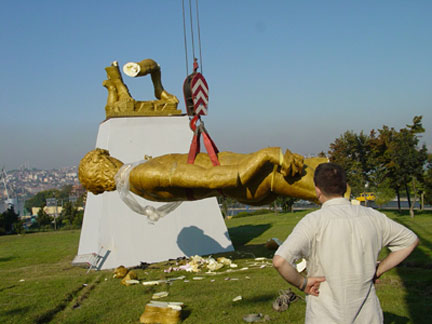
Serkan Ozkaya, David (inspired by Michelangelo)
DA: The nature of every discursive beast...
SO: Or like the politicians say every now and then: "It's not the right time now to deal with the arts/literature/philosophy/music since we have to deal with poverty/terror/sicknesses/earthquake and/or more important/privileged problems."
DA: A lot of art works in Turkey have been produced with quiet strong socio-political threads, but barely any local feedback, be it critical, theoretical, or journalistic. Maybe this actually helped the production ever more. Do you think a time will come when this kind of genuine response system will settle in? Is there already a critical discourse emerging in mainstream media- as a result of the Fall, or in general, the biennial?SO: You know I feel envy when I read some interviews by Western and/or successful artists. They're so free-floating and up there somewhere.
DA: Floating in their vacuum, you mean?
SO: I mean that they deal with abstractions all the time even in their interviews with magazines and papers (free-floating.)
DA: Do you find this to be a luxury item? Do you know about the World Question Center by the artist James Lee Byars? He wanted to lock 100 of the world's most brilliant minds in a room and have them ask each other the questions they had been asking themselves… This was restaged a few years ago.
SO: I am familiar with James Lee Byars' project and it was precisely what I meant with impotency. One anecdote I heard from a curator of this project is that they called up some VIP and asked him, "What is the question you ask yourself?" And this influential person replied instinctively: "I beg your pardon?" I guess that's the most relevant question one can imagine.
© Defne Ayas and Serkan Ozkaya, October 2005, Istanbul-Amsterdam-New York