Interview with Ira Sachs
by Allen Frame
Ira Sachs is a New York-based filmmaker who grew up in Memphis and has made two feature films there. His latest, Forty Shades of Blue , opening in New York in late September, won the Grand Jury Prize at the 2005 Sundance Film Festival. Atmospheric and sensual, it weaves the tale of a love triangle-- between an aging father who is a legendary rock 'n roll producer, his beautiful and proud younger Russian girlfriend, and his bruised, estranged, intellectual son-- stuff for Greek tragedy, but adapted to the contemporary South in a haunting, elliptical way. Sachs' earlier film The Delta, from 1996, is another anxious love story in which a half-Vietnamese, half-black immigrant to Memphis becomes involved with a closeted gay teenager. Mesmerizing in its episodic structure, it gradually descends to a shocking moment of unexpected violence.
The website for Forty Shades of Blue is www.fortyshadesmovie.com
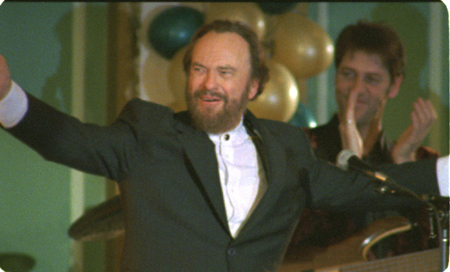
Rip Torn as Alan
AF: In both your feature films you set up a romantic collision between people of different cultures. In those conflicts between outsiders to Memphis and people who...
IS: Belong.
AF: Who belong, right, I was wondering how your own status as an outsider in Memphis informs that perspective, for one thing, your being gay, for another, your living now in New York, outside the South.
IS: There's a combination of things which involve, having grown up both as a gay person in Memphis and also as a Jew in Memphis, and a liberal, and having a father who was different from a lot of people's fathers, different ways in which I think that I both totally belonged because I was upper middle class and white and privileged, so I certainly felt a part of that city, but I think all those different forms of being outside are also what made me an artist. I often think that, particularly, if I weren't gay, I could be a lawyer. I have the mind to be a lawyer. Being a film director is not that different from being a lawyer in certain ways. It's a business in which you have to understand economics. Notice I used the word business immediately. I had a perfect position to be observant in a city like Memphis because I have both incredible intimacy with that city, an intimacy that I don't have anywhere else and I don't feel in New York really. I didn't go back to Memphis until 10 years after I left there, but I had a certain position from which I could view things really clearly. I knew all the streets so well. Childhood is made up of so many thousands of days. There's no recreating childhood. And there's your sort of open assimilation of all the facts that are around you, and also the culture that's around you, so you're slowly absorbing things in Memphis around race, and as you said, being an outsider, to the extent that it's something you feel in just the most deep way without really even having a consciousness of. So I find that I go to Memphis and I have an immediate associative artistic frame of mind. I go right into it. I think the unconscious part is essential to being good at telling stories, and then you become conscious so you can control, as well, those same unconscious emotions.
AF: You're a "returned" Southerner rather than an "exiled" Southerner.
IS: Yeah, I'm not exiled. I've made two films in Memphis, and each time I've lived there for four or five months in order to make those films. The city is fascinating. I pick up things really quickly. When I've completed these films I have wanted to leave, pretty much, right away. I'm not tempted to stay, and I think part of that is that my life in New York is a much more verbal one and a much more analytical one, which is something I don't feel very much in Memphis where people just do things. Things happen. People's lives are extremely complicated and rich and messy, but there's not as much dialogue around those experiences, and now, I've lived in New York for 16 years and gone through psychoanalysis and various things which have made me a New Yorker, not a New Yorker necessarily by birth, but by language, really.
AF: I'm curious about that process of going and spending half a year. Do you go with a plot outline and basically the setting?
IS: I did very different things with these two films. With The Delta , I wrote a script which was based on memory and of growing up as a closeted gay teenager in that particular city, and then when I moved to Memphis with my producer Margot Bridger, I rewrote the script completely based on people I met there who were living in Memphis in the present day. So all that was there was a sort of archetypal story structure, but then it was completely transformed by three or four months of improvisations, meeting people. All the people in The Delta are non-professional actors that I met pretty much in the environments in which I later filmed them, and that particularly was true of the character played by Thang Chan, who's this half-black, half-Vietnamese gay immigrant in Memphis. In the initial draft of the script he was a much more peripheral character. The story was really the white guy's story. And in meeting him and opening doors and discovering things that, depths that I just didn't know, I rewrote the script to parallel my own personal experience of how you can know someone in one context or situation and, particularly a foreigner, and if you go into their lives, they become different people. I knew a kid in college who was from Geneva who was living in the town where I went to college. And he was always at parties and didn't go to school there, but was part of our social group anyway, and he was extremely quiet and extremely good-looking and sort of a removed, curious figure that would be in the corner of rooms and in the corner of the lives of people I knew. When I went to visit him once in Geneva, he had a totally different personality. He was the class clown. He would literally stand on tables and tell jokes, and he was the center of this social world, and he was speaking in French. And to me it was so fascinating that the fact that he wasn't speaking the language he felt comfortable in, completely created a different persona. I think that's what I was trying to illustrate in The Delta . That was something that came totally from just being in Memphis and rewriting the script based on everything I was learning.
AF: And then, how much is rewritten through improvisation?
IS: With The Delta I rewrote everything based on improvisation. In a way I think I over-improvised before shooting that film. There were several months of rehearsals which was a slow acquisition of various people who had become part of the troop. And we would do scenes within the locations, but we would no longer be shooting them. I would rewrite based on videotapes that I would take, and the script would transform, but ultimately, I think that for non-actors to have gone through the scenes so many times affects the performance quality. It's not as easy for them to do something over and over, so I think I just over-worked on some level on The Delta .
AF: But at the same time losing your lead at the last minute must have freshened it up a little.
IS: It did, it did. And what really happened was I lost the lead actor; we'd cast this young kid from Mississippi we met at a bar downtown as the lead, as this closeted gay teenager, and I think the combination of the emotional pressures of trying to play this character, who was sort of conflicted, as well as the professional pressures of trying to suddenly be a part of a film project run by a bunch of high-powered New Yorkers, who were living at a certain speed and expected a certain kind of drive, was just too much for this kid, and he ended up disappearing about a week before we were supposed to start shooting. We then had to stop, go on hiatus, everyone went home, the crew had to go home, and we spent another month and a half, myself, Margot and the Vietnamese actor Thang Chan, who was at that point living with us, driving around and going to bars in St Louis and Nashville. Bars were really good for us, and raves. These three very separate characters who were in search of an actor.
AF: Did that Mississippi guy wind up acting later?
IS: No. But he did wind up contacting me about five years ago, which was probably five years after the film, because he'd seen the film.
AF: I'm curious about that kind of regret, that kind of lost opportunity for someone outside the center. It must weigh on your mind.
IS: Maybe. He told me he regretted it, I didn't know him actually well enough to know how deep that regret was. What I'm more familiar with is the conflict you create for the people you do cast who are in the film who don't become actors. You've given them an experience that they can't re-create, and I think each person that I worked with probably had a different experience. They've all gone back to their lives, and you feel some guilt and sense of responsibility about that. Forty Shades of Blue was a different situation in which I decided to work with professional actors, and I worked with a co-writer, Michael Rohatyn, four or five years on the script,
AF: How did he come to be a writer, as opposed to the original music credit he has on The Delta ?
IS: Well, I had written a first draft of Forty Shades of Blue ; the film was based on the music world of Memphis. Michael is a musician, the lead character is named Michael, which was not coincidental. Michael and I had both grown up with larger-than-life fathers. In some ways we were both, and are still to some extent, in their shadows. In different ways-- Michael's father was the Ambassador to France, Felix Rohatyn. He was the artist son, and I was the artist son of a Memphis personality who was in the hotel business with Holidays Inns. It was nothing on the aristocratic scale of where Michael had come from, but we were both in opposition to our fathers. The dramatic tension of the film comes from that opposition to some extent, between the father and the son. So he read the script, and we started working together, and it was a long process to get the film financed so we ended up working together for four or five years on the script. A lot of that process was trying to hone a more classic film than The Delta had been and to adhere to certain narrative demands of structure and arc. There's a classic what-happens-in-a-romance film structure. We would sit and sort of study films like, specifically, there's a Satyajit Ray film called Charulata , which is about a woman who lives with her husband and has an impassioned friendship with a cousin who comes to visit, and it's a beautiful film, and there's also a Truffaut film called The Soft Skin , another triangular romance. There are certain stages of romance that are pretty basic in narrative, and so we tried to adhere to those while at the same time, writing the scenes that tried to match that narrative in much more observational ways than you might find in traditional narrative films. It's a tension-- and I think this is what drives the film and the specificity of the film-- the tension between the observational and the subjective, and the observational and the narrative, and how do you do both of those things consciously at the same time. That's now the thing that I most look for in my own work, when you feel a certain kind of control, a formal control, that allows the audience to relax, to some extent, because they know a story is being told, and they also know there's a style in which it's being told, which is confidently handled, and rigor is ultimately what makes art films better or worse, the level of rigor. I think Forty Shades of Blue is a much more rigorous film than The Delta . What's sad to me when I think about The Delta now is that I couldn't make it again, and if the idea of The Delta , a story of a white urban boy who meets a half-black, half Vietnamese gay guy, and they run away together down the Mississippi River, if I thought of that, I would put it out of my mind because I would have no way to make it. The death of independent film is not a tragedy, but it's just a reality, and the reality is that it totally affects what stories can be told.

Dina Korzun as Laura and Darren Burrows as Michael
AF: As it's become a much more pressurized commercial arena?
IS: There aren't alternative narrative careers in American cinema, careers being the operative word, meaning that if you want to make 15 films in your life. If you want to make one film, two films, you can make any film you want to make, but if you want to make 15 films, there's no process of telling stories that are very narrow in their appeal. You have to appeal to broader audiences, or you can't get the money. You go to film festivals, in the states, like Sundance, and you still see films that are telling stories about characters that you wouldn't see in other films, but what you don't tend to see are films that are told rigorously.
AF: Stylistically, your models seem to be mostly not American films, in the way your films feel, with more attention to atmosphere, mood, psychological subtleties of storytelling, an elliptical mode of storytelling as opposed to something more direct. All that does not seem typically American, not even very "indie" American. Do you think it has to do with the fact that you didn't go to film school?
IS: Right.
AF: And how that might have allowed you a freedom to find other models instead of being forced into more straightforward, or formulaic modes?
IS: I think that's true. I think that, in the most kind of autodidact kind of way, I learned how to make films by watching a lot of films. If I'm going to do something, I'm going to be an afficionado about it, and I was aware that it was an education. And I enjoyed it, but also, I was very serious about it and developed a relationship to international cinema that was very organic to me. I found myself moved by movies that were not made in the U.S. and having a very natural relationship, as an audience member, to Taiwanese cinema, to French realist cinema, to Indian cinema, various kinds of storytelling modes that were not prominent methods of American cinema. I would agree.
AF: That influence must then be both a liability and a strength.
IS: Well, my new film is a very American film, and the style is American.
AF: You mean Forty Shades of Blue ?
IS: No, my next film. It's a very American film, a suspense film, but I'm actually watching Turffaut's "American" film--again, this particular film by Truffaut, The Soft Skin , shot by Raoul Coutard, which is kind of Truffaut's Hitchcock film. And because of Coutard, in a way, it's also very much a humanist film. I always look for models, and for Forty Shades of Blue it was a series of films that were made by Ken Loach and Chris Menges in the early 80's, specifically Kes , and a film called Looks and Smiles , and another film Loach made called Family Life . This was a point at which Loach was much more interested in an aesthetic approach to realism than he is now where aesthetics are not so important to his work. But at this time his work was, it was like photojournalism, it was very beautiful, the lighting was beautiful, the framing was very beautiful, and it was a sort of unaesthetic, aesthetic realism. Which is a complicated thing to achieve, and both in texture and very much in shooting style, those films became a blueprint for how we would shoot Forty Shades of Blue and a blueprint that my cinematographer and I had to learn through struggle. And also had to find for ourselves so we weren't imitating. It was a process for me of trying to articulate what it was about those films that was just so affecting to me on all sorts of levels, aesthetic, emotional, any of those kinds of things. In my new film I've written a genre film that's certainly more commercial, and I think at half the meetings I'm an asset and at half I'm a liability, and I would say that the money will end up coming internationally primarily more than domestically. I'm less of a liability internationally.
AF: I read that a particular favorite film of yours is Cassavetes's The Killing of a Chinese Bookie . I saw more of that kind of improvisatory looseness in The Delta , and Forty Shades of Blue seems more controlled, more elegant. But what about Cassavetes?
IS: I first saw Cassavetes's films in 1986. I was living in Paris, I was a college student, I didn't speak good French at all. And I was lonely and I ended up going to the movies two or three times a day for three or four months. It was a lonely period that changed my life. I wound up seeing 195 films in a three-month period. I'd never heard of Cassavetes. 1986. He was not known to the average American. I remember I had read one Sunday Times Arts and Leisure article about a movie called Love Streams . That's kind of all I knew. These movies were not in circulation. It hadn't opened in Memphis. I knew 70's films. My father took me to them, so I saw Death Wish , first-run, Jaws , Carrie , I was there. But I didn't know Cassavetes. I saw all his films in Paris, and it changed my life. They seemed astonishing to me. This was also before reality tv. This was before the handheld intimate genre that we now know, before Dogma, before a lot of things. I'd never seen anything like that in film and I loved it. And I responded to it. It was very intimate to me. I made a film in 1989 called Vaudeville , never having made a film. It's an hour-long film, and it was really like me trying as a young kid to do Cassavetes, and it kind of fails. There're some nice things in it, but it pretty much fails. It was a young man's folly in a way, to try to be Cassavetes. Right before I went to do The Delta I saw this Ken Loach retrospective at Lincoln Center. It gave me permission to move beyond Cassavetes for myself which is to move into something that I think is probably more like me, in the sense that I'm not as aggressive, I'm not an actor. Those are very actorly movies. I think The Killing of a Chinese Bookie is the least actorly of them.
AF: The most atmospheric.
IS: It's the most atmospheric, the most simple in terms of performances, though, on the other hand, I've grown to think of Opening Night (and it was the film I resisted most) as an absolute masterpiece. One of the things I love about Opening Night is that it's artistic, it's aesthetic, it's consciously created, it's just a much more constructed film than his other work, and I like that now because that's the kind of film that I'm now more drawn to, where you see that a more formal approach is taken to the artifice of movies. So then I would say I got over Cassavetes to some extent, but then in certain scenes in Forty Shades of Blue , I'm just thinking of Cassavetes. The scene with Rip Torn and the girl he meets at the hotel room is to me like a very loose homage or borrowing of certain feelings and images from Husbands . There're great scenes of women and men in hotel rooms. I love that. Cassavetes was a major influence, was a major experience. What's nice is that eventually you do just sort of internalize these things. These other movies are as much a part of me as like, where I went to college, or just like my friends--they're just there. But I can't watch Cassavetes anymore, and I don't go back to Cassavetes. Now I go back to The Soft Skin or Bresson constantly. In a weird way I keep going back to a lot of French films.

Rip Torn as Alan
AF: Some of your casting decisions seem to be a nod to films or filmmakers that you like, for instance the casting of Paprika Steen from Thomas Vinterberg's The Celebration or the casting of Dina Korzun, seen previously in Pawel Pawlikowski's Last Resort .
IS: Well, they're not nods to the filmmakers. If I've seen someone be brilliant in one film, then I have the confidence that if I have the right role for them, then they can be brilliant in my film. But with actors who have a lot of work that you can look at, if I haven't seen them be brilliant in anything, then I don't feel necessarily that I would be the one that would make them be brilliant. There's just a certain kind of acting style that I respond to. I cast this actor Darren Burrows in Forty Shades of Blue . I had seen him in a couple of small independent films, and he was a character actor, and I thought I saw something in him that could be used in a more leading-man way. I hope I gave him a good film. But I definitely keep a list, or I watch a movie and see a good performance and I tend to jot it down-- and Paprika Steen, I always thought I wanted to cast her in that role, but it didn't seem like it was going to be possible, based on how much money we had to bring people in or out, and then about two weeks before we started shooting, we hadn't cast that role, and I called her agent, and I spoke to her the next day and she got on a plane and came to Memphis three days later, and she was really game and she's been amazing personally.

Darren Burrows as Michael
AF: Back to the content of Forty Shades of Blue , this towering father figure. I know that you've made two short films, one about fathers and gay men, and one about your own father and his womanizing. I'm curious how your relationship with your father may have spilled over into your relationship with the actor playing the father, Rip Torn.
IS: I don't connect my relationship with Rip with my relationship with my father because they're so different as people. Rip is really, really tough, really, really smart, a really volatile actor. My father has no temper. He's never gotten angry with me, ever. He might have been disappointed with me, and there was a 10-year-period in which we had difficulty talking, which is the opposite case now. Rip is also a father, and that's an interesting part of his process to create the character of Alan. He's a very loving father who's very involved with his kids' lives, and there's a sensitivity in Rip that I think is the part that's the most lovable, and I think it comes across on the screen. Even though there's this volcanic nature to his presence, there's a sensitivity that's also present within the next moment, if not that moment. I was talking last night to a friend of mine who has just taken on a new job. I was saying, I think for me one of the things about becoming professional in the film business and also one of the things about making films on an artistic level has been to learn as a gay man how to deal with straight men, how to be a straight man, really. There's a lot of performance that takes place. All of my films are on some level about what you perform to the people you're closest to and what you perform within the society you live in, what are the levels of acting that one goes through in life, how many different characters do you play in life, and I think the same is true as a film director, that each aspect of the experience is a certain role that you try to get better at. Forty Shades of Blue is the first film I made in which I didn't have total economic control. Which meant that I was living in a world in which I had to deal with men with money. That's something that's in the film, what do you do with people who have money, and the challenges, meaning the financiers, and standing up for a particular aesthetic vision, and having to be a motherfucker, which is kind of something that I've had to learn. And it changes you. I mean I really think that besides certain pleasures that I take in the film that I created as an aesthetic object, I take personal pleasure and a personal sense of strength in the fact that I was able to fight the fights that needed to be fought to keep my own film as much in my control as I could have. And I think in that sense, that's a little what the father and son are fighting about. Who has power. And how are you going to get it.
AF: Talking about that discrepancy between public and private behavior reminds me of my reaction to Dina Korzun's performance. Her character's seemingly easygoing in her domestic life, but that is in such strong contrast to the painfully broken sense of her when she's drunk and when she's out in that field with a man she's picked up. The change is so physical; it seems so internalized. I was completely knocked out by her intensity.
IS: What I think is really wonderful about Dina's performance is that she creates a character who I feel is vulnerable and yet not ever victimized. She's got an internal strength as a person and also a craft as an actor that allows you to sense that she's driving the film, ultimately. That's not necessarily in the script. I never thought of her as a victim, I never wanted her to be a victim, but it's a hard thing for an actor to pull off because she doesn't talk very much so there's a quiet to her performance, and yet you always think there's something going on that she has control over. Some internal mechanisms are moving, and that gives you a sense of identifying with her instead of pitying her. That's the last thing that I think she would want anyone to do with this character.

Dina Korzun as Laura
AF: The character wasn't Russian before you cast her, was it?
IS: No.
AF: Was she foreign?
IS: The film took a long time to get financed, and at one point it was Julianne Moore, then it was Maggie Cheung, and then it was Dina.
AF: So you were going with a level of talent and charisma?
IS: I was going with some essential quality that I thought would work in the film. It also needed to make sense to the story. I also tend to be attracted to certain kinds of non-American acting styles. While American acting I think can be quite wonderful, it's based on a Hollywood style which is very broad and at the best; it's Elizabeth Taylor and Warren Beatty, and people who have a sense of star power in their movements, but they're not based in a kind of realistic language. This you tend to find in more European actors. British films are filled with naturals with a sense that each moment is divided into seconds, instead of each moment being a swipe at emotion somehow, so I tended to keep finding myself looking at foreign actresses because it was a style of performance that I was interested in. It needed to make sense, so Russian made sense, Western Europe would not have made sense, Chinese made sense, but why would a British woman be living with this guy? It wouldn't make sense, so there were narrative specificities that had to be achieved.
AF: How was she to work with?
IS: Dina is a very, very trained Russian actress. She went to the Moscow Theater School. She is totally conscious about her choices throughout the film. She has a script that has 75 notations on every page, because she knows what she wants to do, and in a way her conscious approach to the character winds up transforming and defining the film and led me, on some level, even though I was sort of coming to that from my own thought about what kind of movie I wanted to make, led me to make a more artful film than a slice-of-life film. And ultimately I think the film has transitioned from being objective naturalism to quite conscious romanticism in the course of the story, so if the major influences in the earlier film are Loach, to me in the last chapter of Forty Shades of Blue I'm thinking about Fassbinder in certain ways and Brechtian conscious use of camera and film language to tell the story in a non-natural way. Dina's performance really guided that in the sense that in the last chapter of the film she's almost somnambulant in the way she moves through the room. When we were shooting these scenes, particularly when she's getting ready to leave the last night of the film, and her performance was very odd, I was just so excited, not because it was odd, but because it was original, and I bought it. It made sense to me, but not on a naturalistic level, on an aesthetic and emotional level. And then I think the editing of the film is a process of leading up to this stranger kind of performance style.
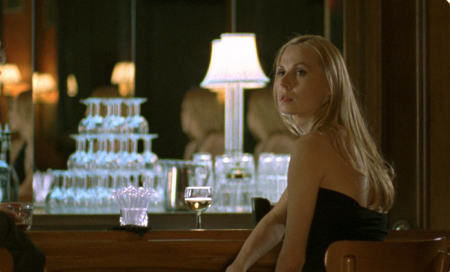
Dina Korzun as Laura
AF: You mentioned that you're affiliated with a group of people called Dependent Cinema.
IS: Yeah, it's been a wonderful thing in my life personally and artistically, and I think it relates to being more interested in world cinema than American cinema. And feeling that what's going on outside of America is my community and my competitors and my challenge and where I learn a lot and where I feel the most anxiety of influence so it fits with all that. Basically, about four or five years ago, a group of friends and filmmakers who are always talking about films and our careers and art realized that the more we knew about what was going on with other people, the more it seemed like we were all going through the same thing, but in isolation. The stories are always the same, the challenges are always the same, no one's inventing anything, no horror did anyone else not have the day before, basically, and so Dependent Cinema is a loosely affiliated group of sympathetic filmmakers who have sort of watched over each other. We're kind of like a band of outsiders, to use the romantic term, who are involved with each other's work on both an aesthetic level and on a professional level, and both levels have been really important.
AF: What's the formal link?
IS: There is no formal link. It started off, Jonathan Nossiter, myself, Karim Ainouz, and Oren Moverman. Oren is a screenwriter who wrote Jesus' Son , is also working with me on my new film, is working with Todd Haynes on his new film, the Dylan Project, and is going to make his first film soon as a director. And the four of us just ended up in New York spending a lot of time together, basically, talking about movies, and then we came up with this idea, called Dependent Cinema, and it's sort of grown by other people that each of us has met, had similar interests, similar affinities, and a willingness to care about each other's work, to put a little bit of something into it because you have to think of the other person's film as your own film on some level, and do what you can to help advise and to make connections, and also to provide emotional support by being present and caring a lot. We just kind of look out for each other basically. It's like any group, it has its moments where it's essential and its moments where it's dissipated. The aesthetic links are loose. It began when all these people were living in New York, and now they're not, so it becomes less present. But particularly during a couple of years when Karim was putting out Madame Sata and Jonathan was trying to make Mondovino , which he was doing for 14 months alone in a room on Prince Street, and I was trying to get Forty Shades of Blue financed, and we were all really hopeful, but it wasn't certain whether we could make films. "Did this make sense?" And that's a very lonely question. And in a way, by creating this group, we could say to each other, yeah, you make sense, keep going.