From Dreams to Hunger, and back again: Carlos Garaicoa
by José Roca
“Utopus, my ruler, converted me, formerly not an island, into an island. Alone of all lands, without the aid of abstract philosophy, I have represented for mortals the philosophical city. Ungrudgingly do I share my benefits with others; without hesitation do I adopt whatever is better from others”. [1]In his manifest "Aesthetics of Hunger" (1965), the Brazilian filmmaker Glauber Rocha affirmed that the noblest cultural manifestation of hunger was violence. Such ethical demand of the active insubordination against misery and oppression (written at a time in which Brazil was just inaugurating the utopian capital that it had constructed within the Amazon jungle [2]), coincided with the vertiginous development of the favelas (slum quarters) in the largest urban locations, such as Sao Pablo and Rio (and later on even in Brasilia). The circumstance of the coexistence between favela and mega-projects, between the illusion of progress and the reality of misery, underlines that which has been a constant since the dawn of civilization and its great architectural projects: the utopias of some are made at the cost of the suffering of others. Furthermore, it points out that such a society sustains itself precariously, oscillating between sacrifice (maintained by religion--or the solidarity myth) and the insubordination, in which the instance of control is well known: the repression that retains the multitude under control. Every utopia is built with the purpose of surpassing a form of ruin existing in the present, but, paradoxically, the utopia creates its own ruin (social, moral or architectural) as a byproduct. Brasilia's favela was built with the residues of a great modern project, by those who were displaced; the contemporary ruins of Havana are the result of the fall of the socialist utopia. In this way, there is a dialectic relation between the urban ruin and the project of an ideal society that is articulated through a grandiose and grandiloquent urban project, and that is consequently established as sign of its crisis.

Homenaje al seis, 1992 Documentation of this work in the public space of La Habana
There was a time in which the Russians were no longer there and the resources were not yet there, and from the Wall to the Market there was the only one instance in which the Cuban was alone [3]. The fall of the socialist utopia en 1989 will take Cuba to an extremely difficult situation, euphemistically known as the "special period". Carlos Garaicoa belongs to the generation of artists who consolidated in that period. The difficulties in the attainment of supplies carried to almost total moratorium of the constructive activity, consequently leaving an endless number of buildings without completion that mark Havana's urban weaving as ghost constructions, as nobody's land, contemporary ruins of buildings that never came to be. The initial works of Garaicoa were directed to generate situations in the urban space by means of placing cryptic signs within public spaces that would encourage the active participation of passer-bys, activating the critical view over a city that was falling to pieces in front of the helpless eyes of it inhabitants. In his subsequent works, Garaicoa proceeded by using photographs of the precarious scaffoldings that were provisionally used to keep standing an endless number of patrimonial buildings. With the use of sketches that resembled those made by an architect, Garaicoa proposed fantastic and improbable projects, filled with humor and irony. Auto flagellation, Survival, Insubordination forms part of a project of which different versions have been presented [4]. In the Continuity of another's architecture , presented in Documenta 11, Garaicoa posed the imagined continuity of an architecture truncated by reality's circumstances: "my project begins in the precise moment in which reality was unable to move further on ahead, but was instead kept frozen" [5]. For that project, Garaicoa located the architects who had designed the abandoned buildings and proposed them to produce a rendering of the present state of the structures in order to use the foundations of the ruins to jointly develop new projects. It is somewhat ironical that an artist is probably the main employer of architects , model-builders, designers, and architectonic sketchers in a country in which all non-tourist construction was stopped more than a decade ago. By means of models , plans, animations and isometric projections made with the use of threads on walls, the creation of a fictitious city was erected upon the ruins not of a city that some day was, but of one that never could be [6]. While it may be affirmed that during the genesis of this project the circumstances of Havana were kept in mind, in Auto flagellation, Survival, Insubordination Garaicoa disengages himself from the direct referent of Cuban circumstances in order to address a more universal problematic. The crisis of the modern project and the progressive accounts that sustained it - suppression of misery, hunger, social inequality, the achievement of political autonomy, etc. - is a phenomenon that takes place so much in the Third World as well as in the first; what is more, the recent manifestations of communities against the oppression that supposes the expansion of transnational resources (Seattle, Melbourne, Washington, Prague, Geneva) or against war, give evidence that the dark side of the utopia (whether it is capitalist or democratic) is violence, and that this last one is not patrimony of underdeveloped countries. The buildings of Auto flagellation,…, created due not to reality but to desire, point to the establishment of an ideal community of what is possible: “they pretend to demonstrate the triumph of the imagined versus that of what is real. In this sense, I try to test how History, with the free will of certain politics, can be surpassed or simply put in evidence facing the free and anarchical gesture of the artistic language” [7].
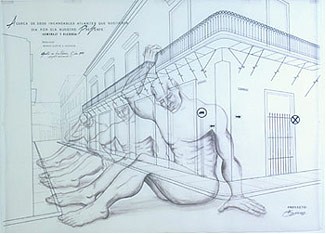
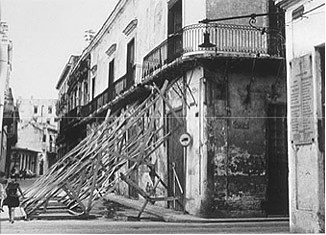
Acerca de esos incansables atlantes que sostienen día por día nuestro presente, 1994-95 Ink drawing on paper and black and white photograph
A utopia may be defined as a project impossible to carry out at the moment it was created, hence, making a utopia a condition rather than a place (or a non-place), a question of temporality rather than a question of space. But the utopist project is set on materializing itself through its signs, the buildings and the urban projects, instead of focusing on changing the sociopolitical conditions that would allow for the emergence of a better society to take place. Not in vain are buildings the first scapegoats when the inconsistency of the project is finally evident: in its condition of symbols of a political project, buildings are reduced to ruins in order to effectively alleviate the thirst for "justice". León Krier, referring to the projects of Speer for Nazi Germany, points out how neoclassic architecture was the first victim, while the factories that maintained the military industry alive were incorporated to the system of capital production of the victorious . And it is not by chance either that the barriers of Ledoux, one of the utopist architects of French enlightenment, were the first buildings to fall before the mad crowds at the dawn of the French Revolution. Just like Krier confirms when referring to the buildings as targets of the catharsis of a postwar Germany that chose to destroy along with neoclassical architecture its relation with Nazism, "architecture is not politics, but its instrument" [8]. This is why it is necessary to differentiate between the symptoms and the causes: that is where the question of architecture turns political. Referring to Thomas More and the genesis of the utopia, Roland Schaer affirms: "When the classical authors recurred to fiction in order to represent ideal societies, they did so, partly, to fool the censors; moreover, by deliberately positioning themselves within the imaginary confounds where everything is allowed, they were able to use their descriptive talents in order to grant the societies they invented all of the attributes belonging to a material and manifest reality, not only theoretically -qualities that pertain to the politics of literature" [9]. This argument also applies to the city projected by Garaicoa. In Auto flagellation, Survival, Insubordination : Garaicoa uses razor blades to make a building, creating a metaphor for the painful construction process of the modern megalopolis; the city constructed with the everyday bread shows that the stability of such project is only possible due to the sacrifice of those who live in it. Just like in the favela , shantytown , bidonville , slum quarter or any other name that adopts the dystopia of the modern project, the auto flagellation and precarious survival are the soil that cultivates insubordination. We live off adversity but, until when?


Acerca de esos incansables atlantes que sostienen día por día nuestro presente, 1994-95 Ink drawing on paper and black and white photograph
Notes
1. The first edition of Utopia by Thomas More begins with an illustration of an island and an example of its alphabet as a way of giving verisimilitude to the story. Along with the alphabet is the poem with which I begin writing this text, in Latin. The text in English is as follows:
Utopus, my ruler, converted me, formerly not an island, into an island. Alone of all lands, without the aid of abstract philosophy, I have represented for mortals the philosophical city. Ungrudgingly do I share my benefits with others; without hesitation do I adopt whatever is better from others".
2. A double utopist operation, if we invoke an artistic genealogy for Utopia: parting from the indications of Antonio de Leon Pinelo in Paradise in the New World (1650) -which placed Eden somewhere in South America- the Argentinean artist Sergio Vega has located it in the Mato Grosso.
3. Paraphrasing the beautiful phrase that Marguerite Yourcenar found in a letter to Flaubert and that inspired her to write Memoirs of Hadrian : "The gods were no longer there and Christ was not yet there, and from Cicerone to Marc Aurelius was the only one instance in which man was alone.”
4. At the Montcada Salon in Barcelona (2003), the Gallery La Casona, Havana (2003) and at the Palazzo delle Papesse in Siena (2004).
5. Carlos Garaicoa, statement for Documenta 11, in Universes in Universe
6. “The encounter with these places evokes a strange sensation: they are not the ruins of luminous past, but of an incapacitated present. We find ourselves facing an architecture that has never been finished, poor in its lack of completeness, proclaimed Ruins even before their existence. It is the true image of the ruin created by abandonment. I shall call them ruins of the future.” Carlos Garaicoa, op. cit.
7. Garaicoa, op.cit.
8. http://zakuski.math.utsa.edu/krier/
9. Schaer, Roland, Op. Cit., p. 3.
Text translated from Spanish by Carina Gallegos.
© José Roca, 2004