Re-enactments in grey-scale
by Pia Lindman
To be published in the forthcoming book “Art in the Age of Terrorism”, eds Graham Coulter-Smith and Maurice Owen, London: Paul Holberton Publications, 2005.I believe in the impact lived experience as such has on people – involving all of its materiality, embodiments, and acts. By performing re-enactments of various social forms of human life, I inhabit life. I hope to engage art as an experience, which has the potential of forcing re-evaluations and a re-processing of life.
I will in the following outline a conceptual framework for my series of art works in progress about gestures I perceive to be expressing human relationships based on affect. I will then investigate in depth one of these projects, the New York Times 09/02-09/03.
Social orders of affect
With my recent work on gestures I explore the various tactics human beings employ to situate the "Self" in orders that organize, value, and signify the reality surrounding us. This is not only an issue of identity, but rather of its tactical partitioning and enactment, deployed to make the "Self" attach to the surrounding order, to fit and even hide within the order. The first work in this series was the New York Times 09/02-09/03. This work is a series re-enacted gestures, based on images I collected off the pages of The New York Times depicting people grieving. In these images, a grieving individual is simultaneously in the middle of global political events and in the flashlights/focus of the media. In this situation, the individual will make an appearance of himself available for framing: fit the "Self" into the order of public media and photography. The “making oneself fit” is a process I believe the individual participates in partly actively, partly passively. The situation is being recognized by the individual to be calling for certain responses. The individual is passive in respect to the situation, he does not create the situation, nor seek to change it, but will simply respond to it by performing – actively – one of the appropriate identities available to him.[1]
The second project I have realized along these lines is Corpcomm, in which the employees of a corporation direct me as I re-enact their everyday gestures in the office. These gestures are not based on my observations, but rather on the way the employees perceive themselves to be performing them, as they go about doing their work. Through Corpcomm, I explored the tactics of employees to situate their "Self" in the order of the corporation, and in a larger sense, in the order of global capital.
The third project, scheduled to be shown in Jamaica Center for Arts and Learning in Queens, NY, in January 2006, is Worship (a working title): Queens is perhaps the most diverse of the boroughs of New York City and consequently hosts a multiplicity of different religions and systems of belief. By visiting houses of worship in Jamaica, Queens, I aim to learn the various gestures that are used within religious ceremonies or that the worshippers make as a reaction to their experiences at these ceremonies. Through these gestures worshippers enact their belonging or, perhaps, longing to belong, to the envisioned spiritual connection, i.e. the order of the spiritual.
Affect is an important dynamic in all of these relationships; an emotional trigger that assures us that we exist in this particular world. More so, the trigger prompts us to enact the appropriate "Self" as well as experience ourselves as that "Self" in the order we are encountering at that particular time. Social behaviorists explain socialization processes by showing us how children learn to feel an emotion by first learning to enact the physical manifestation of the emotion. I understand the distinction between emotion and affect by this socialization process; affect is the reciprocal relationship between a person and his social environment and is based on social conventions[2]. Emotion need not necessarily refer to anything but itself. However, if the emotion has not entered language, it may then also be something of which the person feeling it is not aware[3]. This emotion could be called emergent, because it has not yet, but may be about to, enter consciousness. Affect and the assertion of the “Self” prompt the question of subjectivity. Psychoanalysts and especially the Lacanian tradition of psychoanalytical practice stress the importance of language and the speaking subject in the process of subject formation. Equally, in traditions of Western philosophy, as explained by Giorgio Agamben[4], subjectivity is understood to be what remains of the constant process of subjectification and desubjectification, in which the act of speaking, the utterance of “I” is of essence. In the process of conceptualizing and creating this work, I have come to suggest that there indeed exists something between the verbal and the being of the uninscribed body[5] that is visualized by my work. Gestures are simultaneously both enunciations of one’s biological existence outside the verbal and linguistic. Albeit gestures may be understood as a kind of a language, they nevertheless pertain very closely to the personal experiences of one’s body and to some degree may be manifesting something of it that never enters the realm of verbal language. Michel Foucault’s ideas of bio-power may explain how these manifestations of subjectivity maintained in the realm of the body are systematized and politicized. In making my artwork, I collect, re-enact, and re-trace a repertoire of human gestures. This process opens up possibilities for an analysis of bio-power at work[6]. In repeating these gestures – consciously and studiously – I emphasize the linguistic quality of the repertoire. However, these enactments – as they are indeed embodiments – also maintain their quality as enunciations within the realm of the body and thus something of the uninscribed body is rendered visible. This may make it available to us to look at a process of subject formation that is taking place without language.
The New York Times, 09/02-09/03
Background
My work on grief started with a personal experience of a major public disaster, the attacks on the World Trade Center in the year 2001 in New York City. The spontaneous personal and collective processes of mourning were very visible, intense, and omnipresent in the city after the World Trade Center collapsed. This shared process, that took place in the streets, parks, and squares of New York City, helped me live through my imminent fears and sense of bereavement. I am sure I am not alone in this experience. In indignation of the usurpation of the representations of this mourning via the media for the purposes of justification of war, I asked myself: Who has the right to define how Americans, Palestinians, Israelis, or any other individuals affected by terrorism should grieve and who has the right to make those gestures of grievance public and official? My further exploration through my New York Times project showed me how this is a futile question indeed. The scene is set before the question can ever enter onto the stage.
In the spring 2002, eight months after the attack, I was invited to participate in an art residency program in the World Financial Center[7]. World Financial Center is the building complex right next to the ruins of the World Trade Center. In my residency, I observed people in the environment as they were interacting with the transforming architecture, human flow, and the overarching sense of history in process. These interactions were further made complex by the mix of various groups of people having very different motivations to visit the site. There were the employees of the various companies located in the World Financial Center, who were gradually returning to work and to the site after experiencing almost unendurable trauma on the day of the attacks. There were the myriads of tourists from elsewhere in the United States and from all over the world, coming to the site to have their own personal “brushing” with this history. If not antagonism, at least tension was evident between the two differing groups of people. In the public spaces in the World Financial Center, opaque white plastic covered all the windows that opened up to the smoldering site of the disaster. As long as the site was declared a “rescue and recovery site” – which meant that it was likely that remains of people were still being recovered – public authorities would not allow any visual connection between the general public and the site. In frustration, many visitors had pried and scratched the surface of the plastic in hopes to obtain even the smallest glimpse of the ruinous pit. However, less than two months after the attacks, a viewing platform designed by architects Diller and Scofidio was built on site for the use of the general public. The almost scopo-necrophiliac urge was substituted with a publicly controlled ritual. The viewing platform offered both the possibility for reiterating the spectacular and a place for mourning and reconciliation with a trauma. Here, the act of viewing is perhaps better described as a moment to witness. It seemed not so important to see the site, rather there was a need to symbolically bear witness to it, and to there execute some sort of ceremony, however small. As a facilitation of these personal acts of mourning, the viewing platform itself was the architectural and collective gesture of mourning. In first response to this site at this particular moment in history, I made a video portrait of the viewing platform, which was later shown in the plasma screens in the public spaces of the World Financial Center.
In June 2002, the site was declared a “construction site” and the visual impediments, as well as the viewing platform, were removed and a wholly new organization of spectatorship, memory, and site developed. Again, ritual was replaced with a search for the spectacular: cameras came out and the pit became as if a monument against which family members posed. Guided tours targeting tourists were based on detailed legends blending in official history and personal experiences. These legends were retold by the guides in street corners, next to piles of rubble, and even next to the plasma screens showing the video of the viewing platform, which now had become part of the memorialized past.
Grieving Processes and Public Media
Observing the various grieving processes at the World Financial Center – and indeed, all of the moments I describe in the previous passage are grieving processes – I have seen in practice how emotional response in a social context does not directly correspond to the bodily functions producing an emergent emotion. In order to give these emergent emotions shape, to communicate them to the world and ourselves, we enact them by cultural forms. Furthermore, if the expressions become meaningful to others only as cultural shapes, an individual's emotions may take on a “life” of their own; they are given form and direction within a society that are dependent on its structures, rather than on the individual’s personal experience[8]. This is how personal emotion at the point of its emergence to consciousness is - as Althusser states it - always already socially constructed, an affect, and political. In highly publicized traumas the media captures personal expressions and transforms them into public collective performances that may be used by opportunist authorities to promote their political goals. Within the functions of the biological body we can imagine a moment between emotion, its coming into consciousness, and affect, i.e., emotion based on social conventions. This moment can be a process in time. It is in the concentrated intimacy between oneself and one’s biological self that one is supposed to learn how one feels or thinks about something[9]. In a situation where personal and public collide to become a joint performance for television cameras, this moment is squashed and emotion is short circuited into affect. One is made to feel before one has been able to present the emotion for oneself. In performing one’s affects in the public in this way, the concerns are with the audience and the repertoire is a given. However, the uninscribed body that one is trying to fit into the social order by the grieving process is left uncommunicated. Some observed reactions from the audience seeing my work suggest that the work opens up a possibility for reprocessing this lost moment of emotion.

photo: Si.si Klocker
I have now looked at how personal emotions become public performance – especially when framed by public media, which has participated in creating a contemporary culture of grief (and of other emotional processes rendered collective). We may very well talk about cultures of affect. Public media also partakes in transforming the personal into fake universalism, which at first glance may seem to be bringing together diverse cultures under the umbrella of universal human emotions[10]. However, the universality of the expressions of grief we observe in the public media does not derive from the direct human response to individual internal processes via culture, but from a response to the mise enscène created by the presence of the camera – or more precisely, the mobile media machinery units on the sites of disasters. This scene sets the emotional responses before anything else may happen and invites site-specific performances, however, only specific to the media company that happens to be recording and broadcasting at that moment. The media company stakes out the parameters of the site, chooses the elements to be used to obtain the effect and meaning that is sought after. The actors are equally chosen and posited within the frame, even though the actor may be any passer by.
The Collecting and Re-enacting of the Repertoire
To engage these issues by ways of art, I collected images from the New York Times, from issues published between September 2002 and September 2003. Eliciting the bodily gestures out of the news context I made drawings/diagrams of these gestures by tracing them with pencil on vellum. The images ranged from mourners in the aftermath of the World Trade Center, terrorist attacks in Israel, funerals of Palestinians, Chechnyans being attacked by Russians or vice versa, to African American teenagers killed by police. Using these drawings as my “instructions”, I re-enacted the gestures in front of a video camera without revealing their original context. I have not invested the re-enactments with emotion, nor have I interpreted the enactment as an actor would perhaps do. I simply wanted to repeat the physical gesture with my own body as accurately as I could. I then printed out my poses of these gestures from stills of the video recordings. I traced by pencil on vellum almost four hundred stills. By exhibiting both the tracings and the re-enactments, I aim to illuminate some of the relationships between a photograph, its mediation, and the idea of original content, in this instance human emotional reaction to terrorism. The video of the re-enactments is titled Lakonikon and the drawings edited and composed in several books are titled Black Square. The Lakonikon video shows me adjusting and seeking out the correct gesture, sometimes painstakingly slowly, and often evoking comic aspects of the process. Then there is that moment when I “strike” the pose and stay in it for twenty seconds or so. This difference between the construction of the pose and the pose itself suggest an almost Brechtian interruption in the logic of representation of emotion[11]. By decontextualizing every single image I worked with and by bringing each of the gesturing human bodies to the same scale and similar form of – laconic – representation, I attempted to discard as much of the politics of affect of photographic representation as possible and instead analyze the gestural repertoire of grief.[12] It was foreseeable that the politics of affect of social conventions and identities of the viewers would emerge - perhaps even more than when comparing images in The New York Times. What I had not foreseen, however, was how the simple pencil line drawings of myself became almost like empty containers, depositums, creating room for emotional investment by the viewer, something I perceive all but lost by the browsing of one’s daily newspaper over breakfast, or better yet, the flow of multiple images and crawling texts on today’s hyper-mediated television or computer screen. I mentioned earlier in this text that my audience finds opportunity to reprocess lost moments of emotion with my artwork. These drawings are the very site for that process.
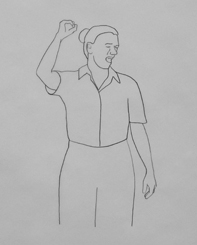


Pia Lindman, 2004
After re-enacting in front of a video camera in my studio, I have now moved into the public space and perform the re-enactments live. The locations of my performances have varied, and range from a window display at a New York gallery to Foley Square in downtown Manhattan in front of the Freedom of Expression National Monument[13]. In November 2004 in Austria, I took the audience on a guided tour through downtown Vienna and performed for approximately five minutes in front of each monument we visited. The itinerary traverses points of interest suggesting the societal interconnectedness of religion, genocide, corporate capitalism, oil, global market, imperialism, charity, and policing. Among others, I performed next to the medieval monastery of Schottenstift[14], Rachel Whiteread's Holocaust Memorial on Judenplatz, a view of the OPEC Head Quarters[15], Maria Theresien Platz and Fountain[16], and a memorial for policemen killed while on duty[17].
I consciously framed myself by the monuments and allowed a dramatic dynamic to emerge between my gesturing body and the various motives of the monuments. I see these monuments as potential containers of collective emotions and memories and my aim is to set them in process. Most often the collective emotional and social process needed to come to grips with an historic event (which always also means trauma, however victorious it might seem from a narrow perspective) to the point that we may seriously speak about healing, is replaced with public authorities seeking to package the event into an aesthetic modality informed by myths of heroism, national unity, victory, etc[18]. By the erection of monuments, official history closes the arteries of a healing process on an individual, but socially shared level. However, as I stated before, the monument is a potential container of collective memories and emotions: by performing the gestures of grief I aim to bring into relief the irony of my mimesis against the containment and stasis of the monument, effecting an unraveling of the sincerity and authority – the inhibition - of the monument. Take for example the enactments I performed at the Schottenstift monastery. I chose to perform next to a relief depicting Heinrich II Jasomirgott, the 1155 founder of the monastery. The King is looking down on a subject kneeling in front of him. I tried to locate myself in the trajectory of the gaze of the King, thus animating the social and political relationships embedded in the motives of the relief and forcing a contemporaneity onto them. Performing next to the Maria Theresien Fountain made my point even clearer. I re-enacted gestures in close proximity of the equestrian statue on the fountain. My arms gesticulated in similar manner as the statue’s, however, my gestures were temporal and showed a variety of gestures from contemporary media imagery. The variety makes it clear that none of the gestures we see – neither the statue’s nor mine – can be placed in any order of preference, hierarchy, or appropriateness. There is always a possibility of yet another interpretation of what the gestures represent and to what event they refer. There is a multitude of experiences and narratives that may be imagined as the context to my performance as well the performance of the statue.

photo: Si.si Klocker

photo: Si.si Klocker
From monuments to window displays
My friends and I followed closely the only non-cable TV-channel still operating in New York City after the tower with the broadcast antennas had collapsed. Mayor Giuliani appeared almost every hour to report on the situation in the city. I remember him distinctly telling all New Yorkers to not let terrorism take effect, but to go out, go to a Broadway play, a favorite restaurant, book store, etc. In other words, he asked us to continue consuming. At the same time, a New York City government website urged us to stay indoors, tape our windows, and if we had to venture out, wear particle masks.
The monument inhibits collective social and emotional processes from unravelling in public, at least in ways uncontrolled by public authorities. Another social order that captures collective social and emotional processes is consumerism. It offers multiple scenes, mainly in the retail store and various advertisement venues, one of which is perhaps the oldest public stage of this social order of desire and lifestyle identities: the sidewalk and the window display. Performing my New York Times re-enactments in window displays is in a similar manner as next to the monuments an effort to set the locked relationship based on affect between a consumer and his or her objects of desire into process.
Consumer culture has appropriated photography as one its most effective tools for creating affect. Photography also functions as a trace/evidence, perhaps, but it is not the trace-quality of the photograph that makes the full meaning of that evidence. I stated earlier in this text that the media sets the scene at a site of trauma. We respond to this scene, not the trauma itself. The way in which we have already learned to understand photographs as sites of consumption, or sites for enactments of desired lives and lifestyles, becomes an active component of our response to the scene of trauma.
We are indeed trained throughout our entire lifetime to be ready to enact the role of witness the moment the flashlights go off. We are also trained and ready to be on the other side of that “Kodak moment” and to turn that photograph into “evidence”, a socially constructed meaning. Photography as practice and discourse, is a meaning-making structure that simultaneously implicates and interpellates bodies in action. Implicates, as it refers to the actual bodies that are captured by the camera in the image. Interpellates, as in calls for the viewer to experience and fit into the pose of the bodies in the image. In my mind, this structure is more than a language explaining the world: it is itself a world within which every person living today is in one way or another situated. We all know how we should fit ourselves in the frame of a photograph, when we see a camera and even when we do not see a camera. Being constantly as in the frame of a potential shoot is one of our identities. For example, when we see a grieving person in a picture, we imagine the moment of the capturing of the photograph. The picture becomes a gate for our own affective response to the imagined situation. This is how we are prompted to feel an emotion we have learned is befitting, identifiable to us, and pertaining to our identity. The photograph makes a gesture we recognize by way of affect. Indeed emotion can be left unfelt, because we may assert our identity through a rehearsal of affect within the structure alone.
The New York Times 09/02-09/03
Bio notes
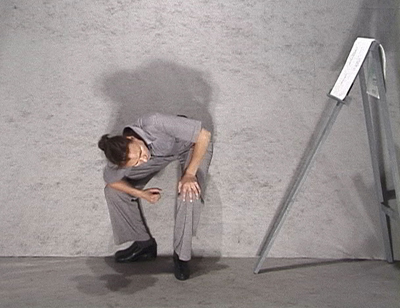
photo: Si.si Klocker
The video of the re-enactments is titled Lakonikon and the drawings edited and composed in several books are titled Black Square. In Black Square Flip Book the drawings are edited so that they may be looked at as an animation. The flip book also includes articles by Barbara Formis and Susanna Cole. Lakonikon is included in the show �Art in the Age of Terrorism� at the Millais Gallery, Southampton, November 2004 � January 2005. Lakonikon and Black Square are included in the show �American Visions and Revisions� at the Kunsthalle Exnergasse Vienna, November - December 2004 and in �Global Priority�, touring in: the Herter Gallery at the University of Amherst, San Francisco Art Commission Gallery, Korea, Istanbul, and Berlin. Black Square is included in �The Book as Object and Performance� at the Gigantic Art Space November 2004 � January 2005. The complete New York Times project with live performances and Lakonikon and Black Square was exhibited as a solo show at the lab at the Roger Smith Hotel, New York City, in September-October 2004. I addition to the performances at the lab, I have performed the re-enactments live in the year 2004 at Sculpture Center on October 24th, 1st of November at Foley Square with Lower Manhattan Cultural Council and Creative Time, as a guided tour in Vienna on the 11th of November in conjunction with the �American Visions and Revisions� exhibition at Kunsthalle Exnergasse, Vienna, and on the 16th of December 2004 at the Gigantic Art Space in New York City.
In conceiving, producing, and exhibiting The New York Times 09/02-09/03, of great importance has been the intellectual generosity of Nuit Banai, Susanna Cole, Graham Coulter-Smith, Erin Donnelly, Grady Gerbracht, Anthony Huberman, Larissa Harris, Susan Jahoda, Laura Lee Pedersen, Sara Reisman, and Matthew Semler. Thank you! A special thanks to John Christ, Barbara Formis, and Jeffrey Walkoviak who bravely criticized my writing and indefatigably worked with me on this essay. I thank all those who took the responsibility to document my performances: Ken Heitmueller, Si.Si Klocker, Alyson Orvis, and Johanna Torkkola. I also want to thank Kunsthalle Exnergasse in Vienna, Austria, the Southampton Institute, UK, and in New York, U.S.A: Lower Manhattan Cultural Council, Creative Time, Gigantic ArtSpace, the lab at Roger Smith Hotel, and Trans Urban Roaming Forum.
NOTES
[1] These thoughts are indebted to an inspired reading of Erwing Goffman: The Presentation of Self in Everyday Life, 1959.
[2] “Affect: the conscious subjective aspect of an emotion considered apart from bodily changes”. In Merriam-Webster Medical Dictionary, © 2002 Merriam-Webster, Inc.
[3] Further research into the words ‘affect’ and ‘emotion’ show that distinctions between them are unclear except for the fact that affect may involve consciousness and emotion may exist without it. Merriam-Webster Medical Dictionary: “Emotion 3: a psychic and physical reaction (as anger or fear) subjectively experienced as feeling and physiologically involving changes that prepare the body for action”. In The American Heritage® Stedman's Medical Dictionary, 2002: emotion is defined as “An intense mental state that arises subjectively rather than through conscious effort and is often accompanied by physiological changes.”
[4] Agamben, Giorgio. Remnants of Auschwitz, The Witness and the Archive, Zone Books, 1999. See especially the chapter: “Shame, or on the Subject”.
[5] I am using the concept “uninscribed body “ to denote human existence pertaining to a body’s biological life, which is neither conscious nor of a linguistic subjectivity.
[6] Michel Foucault argues that a convergence of the idea of power and that of the truth form a structure of power in contemporary society that is camouflaged as rationality of the societal and of the functions of the human body. This enables an exercise of bio-power on each and every individual body by the state in the guise of care for its citizens. Foucault uses the concept of bio-technico-power, or bio-power first time in his introduction to The History of Sexuality (1977).
[7]From 1997 to 2001, the Lower Manhattan Cultural Council, LMCC, hosted World Views, an art residency program in the World Trade Center, NYC. After the attacks had destroyed the facilities of the program, LMCC co-organized with the World Financial Center Arts & Events another art residency program: New Views, World Financial Center. The program started in May 2002 and was completed with an exhibition in the public spaces in the World Financial Center October 2002-January 2003. In the introduction to the exhibition catalog, Moukhtar Kocache, director of Visual and Media Arts at LMCC, states the purpose of the new program: “to provide artists and the council the opportunity to respond to emerging political and cultural realities”. The artists in residency were asked to “consider the psychological, geographic and traumatic experiences of the site” (Ibid.). For more information, please see LMCC website: http://www.lmcc.net/Residencies. See also exhibition catalog: “New Views, World Financial Center”, Lower Manhattan Cultural Council, 2003.
[8] Reading Althusser’s notions of the Ideological State Apparatuses forces me to question the possibility of any personal experience of emotion in any way differing from those that are available in the repertoire of emotional experiences of the society within which the emotion emerges. However, I am using the distinction of personal vs. public for making this point of how the public media may interpret something that we perceive personal and unique into a message quite different from the personal perception. Indeed, this is how personal is public. Althusser, Louis: “Ideology and Ideological State Apparatuses (Notes towards an Investigation)“, in Lenin and Philosophy and other essays by Louis Althusser, Monthly Review Press, 1976, U.S.A. First published in La Pensée, 1970.
[9] This process is understood as a personal matter, however, our beliefs regarding its proper forms may very well be socially constructed.
[10] Grieving Lady Diana changed the forms of grieving in many parts of the world. In Finland, teddy-bears were not commonly used to mark a site of an accident. Now this item has been introduced to the Finnish public grieving culture’s repertoire.
[11]Regarding alienation effects and illusions of representations, see for instance: Bertolt Brecht, “Alienation Effects in Chinese Acting,” Brecht on Theatre: The Development of An Aesthetic, ed. and trans. John Willett (Hill and Wang: New York, 1964).
[12] Although not the content of my analysis in my artwork, a structure of how the New York Times seems to organize its imagery emerges clearly. For instance, looking through all the images published in the New York Times, issues from September 2002 to September 2003, I made the following observation: whenever a bomb had detonated in Israel and the consequent retaliation from the Israeli army upon Palestinians had been exacted, the article reporting on the events in the New York Times showed without exception a close-up of an Israeli mother grieving her child and another image of a Palestinian funeral-turned-riot: a mob of angry men throwing stones. Perhaps we understand the dynamics of the violent acts, but the psycho-dynamics of the affects from the two juxtaposed images put another kind of twist on our collective mind. It is easier to sympathize with a grieving woman, especially when shown in close-up, than it is with an angry mob of depersonalized men.
[13] Please see notes for The New York Times 09/02-09/03 at the end of this text for more information on each location.
[14] As many monasteries in the medieval times, the monastery of Schottenstift was open for anyone to enter, stay and be sheltered, even if he or she was the worst kind of criminal. This is also why the plaza next to the monastery is called Freyung, a space of freedom.
[15] At the end of Judengasse, where the street transforms into a stair leading down to the Donau canal, from the top of the stairs, one has a view over the canal to the OPEC Head Quarters. This building was the site of a 1976 kidnapping by infamous Carlos the Jackal.
[16] Maria Theresien was the sole female empress of the Habsburg dynasty. She was popular enough to acquire the title “Mother of the People”. Although not abolishing serfdom, she alleviated the living conditions of the serfs with her law reform Robot Patent. She tolerated Jews as long as they converted to Christianity.
[17] Across the Burgring from the Maria Theresien Platz you find a steel monolith, a memorial for policemen killed while on duty. This monument is at the edge of Heldenplatz and next to the Burgtor, both monumental constructions of the dubious Austrian history of the 1920’s and 1930’s, marked by the eventual nazi invasion.
[18] My dialogues with artists such as Dennis Adams, Antonio Muntadas and Krzysztof Wodiczko have inspired me greatly in my own aspirations to make critical artworks around public space and especially monuments. Also the work of Jochen Gertz has been of great influence to me.
© Pia Lindman 2005