Interview with Pam Lins
by Matt King
Pam Lins is a New York based artist whose most recent solo show, "In Spite of This", was exhibited at Ten in One Gallery in New York in the spring of 2003 and later at Mercer Union in Toronto. She is currently showing new work in "Great Adventure" at Roger Bjorkholmen Gallery in Stockholm. A prolific artist, over the past ten years Lins has created works referencing everything from sporting goods and natural disasters, to the suburban landscape and the architecture of heating ducts. Her sculptures have been described in the press as "unique and unusual," "quirky," "goofball," "puzzling," "modest, provisional," "deliberately unpolished," "inventive hybrid constructions." To complicate matters further, she has recently taken up painting.Matt King: There have been times, usually when I'm schlepping some large unfinished object down First Avenue to my studio, when I feel that making sculpture is completely and utterly absurd. Do you ever feel like what you do is ridiculous?
Pam Lins: Oh my god. I can't believe I have to fill up that studio again. I can't believe I have to make one more sculpture – ever. But on the other hand it's the picture of you hauling that thing down 1st Ave. that makes me feel there is some drama in making sculpture that could be one of the reasons I'm still interested in doing it. Of course this shouldn't seep into your real life too much, that could hurt you. Also, I still see work that makes me feel that it is still viable to be involved in this practice. On the other hand I'm all over the place and I allow myself to go as inclined, so it is possible I won't ever make another sculpture ever again. I'm not against the studio being a place to read or space out or turn things upside down or drool.
MK: I've always found the idea of "play" in the studio difficult to articulate because of the popular notion that artists are flaky, childish and self-indulgent. And yet now more than ever it seems necessary.
PL: Well, you forgot dumb. And I think playing has been important to artists for some time. I mean, think of Deiter Roth, and oh about every other artist. But I understand the necessity you feel, given the current climate in New York, which seems to have something to do with compliance and direct quotation and comfort as content. It doesn't seem so much about play anymore. I can't help but be romantic about New York in the 60's, yet I have an amazing community I get to ride with.
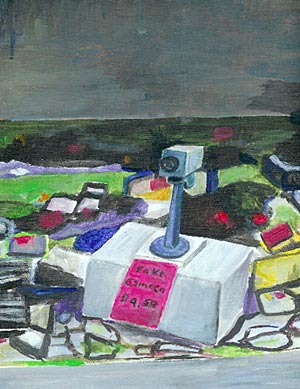
MK: And laugh with! There is something undeniably funny in your work: from the "fake camera" painting to the vented pedestals, you seem to enjoy poking fun at the seriousness of art.
PL: I'm seriously attracted to coexisting contradictions – big fat guy with little dog sort of thing. I take Buster Keaton as my model for this approach. He always needed water for his gag. And it wasn't very often about the water. And hey, aren't jokes serious? Also, there can almost be an element of "cute" in my work, and that seems really hard for most viewers, or at least critics, to grasp as important or complicated or layered. They use bears and dogs to sell beer, so the culture at large seems to get it. It's complicated to rely on a misread metaphor.
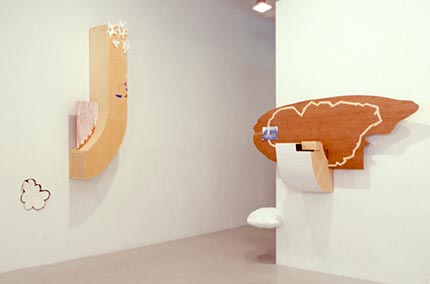
MK: I had to chuckle when I realized that the most solid objects in your last show were the clouds. The larger wooden structures, which seemed loosely based on air ducts, were barely holding themselves to the wall. You constructed them in such an awkward, cobbled together fashion.
PL: Well, as you know, I employ the "don't know how to do things" approach. And I have often included previously untried things and events in my work. I like rushing towards that moment were you previously had never been a painter, and then suddenly you paint.
MK: I thought the addition of "naive" paintings into the objects, combined with your Do-It-Yourself building aesthetic, gave your show a suburban flea market flavor.
PL: I'm more interested in the uncanniness that takes place when I transcribe, or paint the images with what could be called my limited skills, than I am of "bad painting". I like work that embraces falseness or lies. It's a combination of what image I choose and how it's described that gives the results I'm trying to fall into, and my inability certainly jazzes that up. In the same way, I enjoy not knowing how to build things in the manner of a carpenter. I'm making art, what are you doin'?
MK: Do you think of this in terms of gender?
PL: No, absolutely not. What I like about art is that it allows for non-specificity. On the other hand, I consider the approach political. Describing what I mean by the approach is a bit more difficult. It's not about how the work looks. It's a combination of making work, entering a place where work is and addressing or combining this with the limitations of how we think about what came before.
MK: A way of "being" with the work?
PL: Not really a rational approach, but a mode of operation.
MK: What do you think of work that employs a more tightly controlled technique?
PL: As an artist I'm super interested in work that is anti to mine. I can't say that work like that does not engage me. It does, sometimes just because it is unlike some of my work. It's the reason I'm such a fiction junkie – other worlds. Control seems to have more to do with efficiency and perfection which is not an organic process. More analytical? I don't know. For me, the other way is more about imperfections or unpredictability and that seems more related to a life. It allows me to work a bit, think about the structure, question it, fix it and so on and so on.
MK: And despite how thoroughly manipulated the objects seem, you manage a light touch?
PL: How it's made is how it operates, or presents itself.

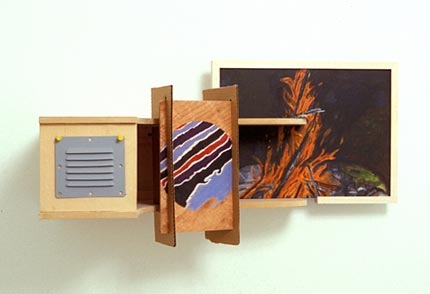
MK: I remember seeing sawdust and a pushpin lodged into the corner of one of the duct pieces. There is a sense that the objects were labored over, cut apart, reconsidered, reattached, and then quickly abandoned, as if something was satisfied in you that is not necessarily discernable in the piece.
PL: The recent work had a making/breaking/fixing procedure that I followed. I'm interested in both construction and reconstruction, so this process satisfies both inquiries. Sometimes I create limitations that paradoxically open things up for me. But the work has a self-consciousness built into it, also revealing their built-ness, and that brings you back to the "how they operate" thing. Also, I like the sense of scale a pushpin or some sawdust can offer.
MK: I get the feeling that the work is hollow, beyond the obvious fact that they are empty.
PL: I'm aware that there was a time when there was no hollow sculpture. Hollowness is often political but sometimes it's just empty or revealing of a more active inner life.
MK: And this process of breaking and fixing not only makes the work look active, but makes it feel like as if I encounter the piece in much the same way you do: as a potentially changeable object. You leave open the possibility of revisiting the work, if only mentally, in a way that contradicts our usual expectation of sculpture as an object unchanging in time.
PL: I always think I'll get back to that coffee table that's not fixed properly and splits open if you put two plates and a beer on it. Or that bed that's missing a leg which is substituted by a brick and a copy of The Bible, and the duct tape holding my dashboard closed. I like to think of unfinished and broken as the same beautiful failed place. Finality, although ambitious, is often disappointing.
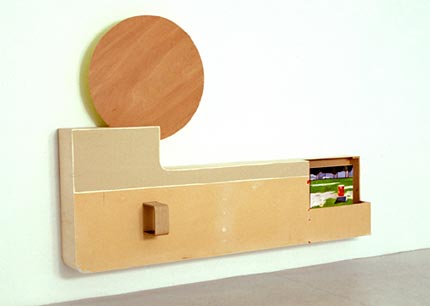
MK: And even though images of clouds and vents dominate the show, a brick and a Bible could just as easily have found a home somewhere in the sculpture.
PL: There are elements in my work that are there when I'm making it that don't always make it to the final presentation. This is so I can assist my process and take liberties with the "how do you generate work" phase. This also gives me something to do in the end, besides just having a piece of sculpture. I can take away the object or edit the notion the work was generated around, the focus, or think about how the work will function within a space. It leaves a "here" and "not here" feeling. Through my weird choices of associations, I'm trying to create some sort of metaphor for a contemporary condition – one that seems pretty alienating, but has moments of optimism. I still totally believe in the individual experience.
MK: This seems to relate to your interest in falseness and lies, that they are necessary elements in your depiction of a contemporary condition.
PL: I'm interested in representation, but not always ideas – no more ideas. I lean more towards representation in ways sublime or metaphorical or physical, more like once it's through the mill. I've always felt that I work more like a filmmaker or fiction writer, as if the cuts in the wood were edits or the pictures were time shifts in a narrative.
MK: But these edits aren't meant to "add up" in the mind of the viewer, in the way that a traditional narrative might.
PL: I'm comfortable with attainable vagueness.
All images courtesy of the artist.
© Matt King / Pam Lins 2004
Pam Lins teaches at The Cooper Union School of Art and The New York Studio Program. For more information contact: plins718@earthlink.net
Matt King is an artist who lives and works in New York City. He teaches at Cooper Union School of Art and the Massachusetts College of Art. Contact: mking7@hotmail.com