Interview with Le Tigre
by Cecilia Dougherty
Le Tigre is JD Samson, Kathleen Hanna, and Johanna Fateman, a band with amazing resilience and a huge mine of musical and political ideas. Their evolution began in Portland about 10 years ago when Kathleen and Johanna met at a show where Bikini Kill, Kathleen's band, was playing. Johanna dug Bikini Kill and gave Kathleen a copy of Snarla, her zine. They eventually gravitated to New York and in 1998 began working with artist Sadie Benning on a project that became the first Le Tigre album. Sadie left the group, but not without introducing Jo and Kathleen to their new collaborator, JD. The rest is herstory.Le Tigre is uncompromising and inclusive, community-minded and visionary, old-school feminist, contemporary, musically clever and deceptively complicated. A group of artists who mix social realism with political fantasy, and who expand the usual meaning of content to include method and intention. Le Tigre takes lyrics and breaks them down into their basic music/sounds and then re-builds them to express themselves, their audiences, desire, need, dilemma, beauty, identification, survival, resistance, refusal, awareness, love and persistence.
I interviewed them online from Dublin, Ireland in February 2004.
— Cecilia Dougherty
Cecilia Dougherty: I've been listening to the three CDs I have a lot lately in prep for the interview, and I am impressed with the range in terms of mixing, political perspectives, the possible audiences, and the guitar, among other things. I was listening to FEMINIST SWEEPSTAKES while looking out the window of the Dublin bus, which provided some interesting cultural displacement. At first it was funny because the music and the band and your history seem very American to me — the sound and the beat, the way you use your own voices, the almost painfully typical American news tones from sound clips of TV or radio that are incorporated into the tracks, and the specific NYC references. Then I began to see where your music intersects with global issues — what sounds like anger is really compassion.
Johanna Fateman: Sometimes we use appropriation (like the TV/radio samples you mention) as the conceptual foil to the expressionist part of our music (mainly our voices). There are so many negative stereotypes about feminist art — that it is didactic, narcissistic, therapeutic, shrill, child-like etc — that I think we want to situate our choices as intentional, experimental, aesthetic, historically-minded, etc. Or sometimes we riff on those stereotypes to reveal their dumb, anti-woman sources. I'm not sure that I'm really addressing what you said... but your conclusion that "what sounds like anger is really compassion" made me think about how we use "anger" in a range of ways — sometimes sincerely, sometimes as a rhetorical mode/persona, sometimes as an sonic interaction with un-angry sounds. And that's part of how we communicate other dimensions of our agenda or critique (for example compassion).

JD Samson: I am extremely excited by your ideas about our relationships to global issues. We all live as feminists in The United States and thus are influenced clearly by U.S. politics and culture. Yet, of course it is inherent that as feminists our politics transcend geographic boundaries. Sometimes I wonder if we are successful in giving that impression to our audience, but whenever we travel outside the United States on tour, I am constantly reminded that it is working.
Even though language barriers exist we are clearly relating through emotion, and as Jo just noted, our "anger". We hear all kinds of ideas from fans about how our American political critiques etc. can fit perfectly into so many different political atmospheres around the world and this is proof to us that we are reaching a more global audience than one might think.
CD: Your music shows more of a sense of history than we usually get in pop tunes — the references to police brutality/the murder of innocent people in NYC in the past few years in BANG! BANG!, for example. It really expresses the feeling on the street and in every conversation I've had with friends about the terrorism of the NYPD. There's also the idea of building on personal history, especially trauma, alienation and feelings of powerlessness, in making the decision to simply stay alive and take power that's behind KEEP ON LIVIN' and LES AND RAY; the use of (what sounds like) actual recorded interviews and chants from the Dyke March as lyrics and percussion on DYKE MARCH 2001.
JF: I think there is a definite awareness of time and place in our music, a desire to be specific in our context/content, and specific about who we are addressing. Conveying a sense of history (personal and public) is part of the feminist identity/agenda of the band, I think. Part of this is a critique of pop music and its constant rehashing of "universal themes" which are meant to apply to everyone (but, of course, don't speak to experiences outside of restrictive pop templates for romantic love and/or apolitical rebellion/partying). The important exception to this kind of pop music is rap and hip-hop and the influence of these forms in mainstream culture. We've been really inspired by speaking positions and production techniques in hip hop/rap that are un-vague, intertextual, "sub cultural," coded, timely, etc. Songs like BANG! BANG! or FYR are already "dated" — but that was always the point, to deal with what felt urgent at that moment and to document the outrages that will be swept under the carpet as time passes.

JD: All three of us attended the Dyke March in New York City in 2001 and planned on capturing this time and place specifically in the context of dancing. We dreamt of writing a song that could become a dance hit in lesbian bars all over. We wanted a song for lesbians all over the world to dance to, to have a song that is just theirs. Lesbian bars shouldn't have to play Madonna, and Young MC. We really wanted to create a song that was actually made by and for queer women all over. We wanted the women marching and exploding with lesbian pride to fuel the song as lyrics and percussive instruments.
JD: "A vast smorgasbord" — excellent clever mixing with appropriated sounds that are used as the intro/lead in to some of the songs, and then mixed and used as percussion.
Kathleen Hanna: The vast smorgasbord song is from our EP and it's called THEY WANT US TO MAKE A SYMPHONY OUT OF THE SOUND OF WOMEN SWALLOWING THEIR OWN TONGUES. Kind of a mouthful huh? I got the idea for it a few years ago while listening to this show on public radio about young, third wave feminists. What struck me about it was how the male commentator seemed to have no idea that his condescending/know it all type tone was making some of the women act nervous and off balance. It just seemed to me that the WAY the commenter and the women respondents spoke to each was the actual content, maybe more so than the words spoken. I used some of the women's unsure style noises, like "uh" and "like" almost as a background drum track to exemplify this, but also because the sound of a semi organized confusion really described to me where postmodernism had, in a way, dumped a lot of "third wave" feminists.
CD: How does the appropriation and mixing relate to the content?
KH: In some songs, like the one I was just talking about, using stolen audio can be a way to take power over material that makes us feel crazy. In other cases, like in Mediocrity rules where we sampled a riff by our friend Carlos' former band the Pee-Chees, sampling was used in more of an homage way. As a way to celebrate the underground punk/garage music that informs our aesthetic. Other times, like in BANG! BANG! its kind of a cheap device we use to express content while hopefully acknowledging that there�s no fake wall between our art and the world.

CD: Can you guys talk about the drum machine? Do you think about adding a drummer to the band?
KH: I personally love not having a live drummer. I mean I'd like to sing with live drums again at some point in my life, but I really enjoy the sound quality, consistency and control we have using drums that we've programmed ahead of time. It's also easier in terms of touring since the screen for our visuals and extra stuff we need performance wise wouldn't fit if we had another person and a drum kit, plus it saves sound check time and time in the studio.
CD: The music definitely has an American flavor — I think it represents completely under-represented segments of our society under Bush, the religious and political right wing, etc. I always knew there was more to being American than being a war-mongering self-righteous ill-educated religious fanatical SUV-driving family man or woman, but the public image coupled with American pop culture really makes us look bad. Who is your main audience? When you're working on the tracks, do you have an audience in mind?
KH: Cecilia you should know YOU are usually who we have in mind while we're making music!!! Seriously, I think it's safe to say we think of like, you, Yoko Ono, Vaginal Davis, and other artists and/or friends who we admire, in terms of who our dream audience is. Some say that we are preaching to the converted, to which we usually reply "We hope they like it!" I mean, it�s not like there is a glut of pop music being made for the beyond left smarty-pants freaks of the world, right?
JD: I totally agree with Kathleen. It is really interesting that our live audience is mostly comprised of 15-22 year old women and queers. Looking out into the audience and finding such young people is really exciting. There is a generation of younger people out there who are interested in creating the same kind of safe space that we want to create. And hopefully this is what makes it possible for us to create such a diverse crowd (specifically in terms of being intergenerational) because we are speaking to our old friends and favorite artists and also to a bunch of new friends and new favorite artists.

CD: The diy aspect of your collaborations seems an important part of what you're saying. The call-and-response/chanting/cheer-leading aspect of the music, which is the beat and lyrics working as one and the same thing, seems integral to identifying yourselves and your audiences as coming from the same place(s).
JD: It is really amazing to play songs live and have the audience chant along with us. Whether or not this is premeditated is hard to say, but when we are playing a show and in chimes a chorus of a thousand it sure feels like we have created a community with the choir of yells throughout the room. Because we all have attended so many rallies and political demonstrations I am sure that this kind of chant/call and response thing is probably directly reflective of this natural way of creating a bond for a common cause. We are cheering and we are chanting, for our new community created by speaking our ideas and playing our shows, for the people who fill that room on that night, and that is the biggest payoff in the world.
CD: In your collaborations, how do you work out your own differences? Are you ever in disagreement on key issues?
JD: The nature of collaboration is that each person brings with them a part of the art and a part of the communication to make that art come to be. Of course that means that we at times are in disagreement, but mostly about smaller things. Luckily Le Tigre shares so many of the same dreams, it is just making them come true that becomes our day to day. In terms of making sure we work out the differences, we mostly just honestly speak about our ideas, and come up with some kind of compromise so that everyone can feel good about the decision and the communication process, which got us to that point.
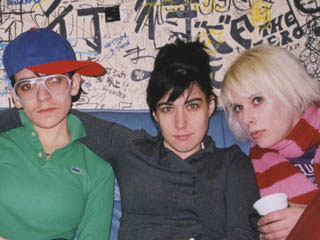
CD: Sound-wise, can you say what each of you brings to the mix?
JD: This is a hard question, because we learn so much from each other and we kind of adopt each other's key elements. Simply Johanna brings the crazy hi hat, the deep bass, and the ever-present duck sounds. Kathleen brings the two fingered keyboard jam, the old school loops, and the guitar chord. And I guess I bring the Dr. Dre, the ding-dong bells, and the organ swells.
Images courtesy of Le Tigre
© Le Tigre - Cecilia Dougherty 2004
Le Tigre Discography:
Le Tigre - Le Tigre LP/CD (2000)
Le Tigre - From The Desk Of Mr. Lady EP (2001)
Le Tigre - Feminist Sweepstakes LP/CD (2001)
Le Tigre - Remix EP/CD
Their website is at: www.letigreworld.com
Le Tigre's CDs are available from Mr. Lady Records and Tapes at www.mrlady.com, and in Europe from Mordam Records at www.mordamrecords.co.uk
Cecilia Dougherty is a videomaker and artist. She divides her time between New York, where she teaches in Fine Arts at Bard College, and Dublin, Ireland, where she and her partner run a bookstore called Anthology Books.
Contact: cecilia@anthologystore.com