Interview with Fazal Sheikh
by Eric Gottesman
Eric Gottesman: In a 1994 Village Voice review of your book A Sense of Common Ground by Vince Aletti, you said, "There must be some middle ground between journalism and art, where you can be honest and still be supportive. I think what art can do is create an atmosphere where we are thinking that solutions are important. The way I am working is not about saving the world; it's just sort of interested in balancing out the scales and thinking that must count for something."I'm interested in that idea of a middle ground between journalism and art. Do you think that "documentary" accurately describes that space?
Fazal Sheikh: It's complicated. Often people try to set barriers between various means of working. It seems to me that whether someone would be strictly described as a photographer or painter serves no real purpose. The point of the matter is: is the work effective?
I think that there should be this sort of fluent quality across boundaries. Documentary, in the best sense, is able to tap into various levels of aesthetics within the realm of art and perhaps as well into political and social issues. I hope my photographs could just as easily and happily be displayed in a political or social context as in a museum. I see no reason that we should limit the way in which the work can function.
I'm not so enamored, clearly, in the way in which the media functions. I generally don't have my work reproduced in magazines or newspapers. I don't make it for that kind of consumption. I'm definitely not willing to sacrifice the individual for a grand purpose, which I have the impression often many journalists are willing to do. Maybe it has to do with what I believe images can do. I guess it's just a personal ease. How do you feel comfortable functioning in another community? I never felt comfortable that way [as a journalist]. But that can also mean that you are a failure sometimes. If you are working in that mode, you might retreat at a moment when you might better make a photograph. I don't know. When I first started, I was much more judgmental in my posture. Now I realize there is strength and weakness in different ways of working.
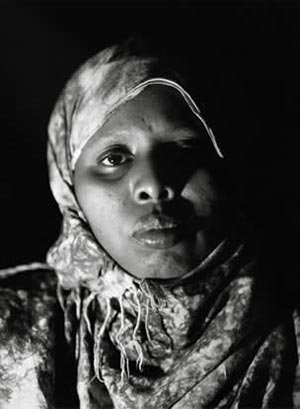
Seynab Azir Wardeere, Asylum Seekers' Center, Osdorp, The Netherlands,
December 2000 (From Ramadan Moon)
EG: You talk about not limiting where the work is acceptable to be seen. Do you feel there are places where it is best seen?
FS: Most of the pieces that I make will either be online or distributed in a very democratic fashion. My books are in essence intended to encourage people. They are sent to institutions in the arts as well as social and political institutions, the media and so forth. Ramadan Moon, my Somali book about the Netherlands, was actually intended to be quite strong politically in that it was sent to most of the judges, parliamentarians, and mayors within the country to underscore what was happening to asylum seekers in the current climate. So this book arrives, sort of unsolicited by them and hopefully they have this experience of it that makes them rethink their policy toward asylum seekers in their country.
I don't know where the work is best seen. People who deal in this kind of documentary work, the plans were always that you were going to change the world and that by bringing these images to the world, you would really raise consciousness in such a way that would affect this grand change. I think you can't really tell how your images will affect people. Part of what I was saying to Vince was: I don't really know if I will be able to change very much. Of course my belief in the process is such that in some unspoken way, I do expect to change things. But if you think too hard about exactly what you are affecting and when, I think that's very limiting.
One of the most gratifying things is for the work to be received and accepted at the source, where you make it. The difficult part is how to take it on from there. The fact of the matter is that, for instance, the Somalis that I was working with don't really understand what it means when you say, "Is it okay for this work to be exhibited in a museum or published in a magazine or a book form?" In really remote areas, you say that to somebody and they agree fully. In my case, I was working with women who were assaulted and they said, "Please, we expect and want you to bring this to the world." But you have to sort of interpret; do they really grasp the significance of that acceptance? Their trust rests with you in such a way that you have to see how it is going to be received in our world or in the First World, let's say.

Halima and her son Ibrahim (From A Camel for the Son)
EG: So are there ways that the work can be misinterpreted? Especially working in Africa, where photographic images have had such a profound impact on international understanding of what Africa is — issues of representation seem especially relevant to someone making images there.
FS: A Sense of Common Ground was really in response to the way in which Somalis were being rendered in the West. I was very timid about this. My personality is such that I don't really want to trespass upon people.
We often discuss the nature of trespass, the nature of propriety. Who has the right to go where to make what kind of image? In the current artistic, or let us say documentary, climate, you'll notice a lot of books being produced by people who are from the place. So the fact that I had Kenyan links made it acceptable and appropriate for this book and exhibition to come out. But to say, "Well, he's Kenyan; he is allowed," sanctions a kind of voyeurism. It separates us from them. The fact that I had a Kenyan link doesn't mean that I am the only one allowed to have that kind of access. That's kind of racist and divisive.

Abdul Shakour's eldest wife, Najiba, Afghan refugee village
Northwestern Frontier Province, Pakistan
(From When Two Bulls Fight, The Leg Of the Calf is Broken)
EG: The notion of beauty amidst horror comes up a lot when people talk about photographs that are political. I'm thinking specifically of what Ingrid Sischy wrote about Sebastiao Salgado's work in the early 1990s: "Beauty is a call to admiration, not to action."
FS: I think Salgado has made some extraordinary images. One thing I would like to say on his behalf is that clearly he genuinely believes and is hoping through his work to affect serious and profound change. I think that is basically unassailable. I have a lot of respect for what he does.
Having said that, I don't particularly feel the desire to make images in that way. I'm much more interested in the specificity of someone's image, name, story, gaze. I want to ascend to individuals. Salgado, I presume, approaches it in such a way that I think he truly believes the people are heroic. You might say that there is some anonymity attendant with that notion. That's very different from what I want to do. I don't want to put subjects into a heroic context. I am interested in people's individual presentations and the way in which that might also challenge our preconceptions and our assumptions of them in that place.
Some of the best photojournalism garners support for aid efforts. Other work, and I suppose mine might be numbered among those people, it may be complex in a way because it doesn't simplify. I hope that my work is not reductive. I hope that it alludes to the complexity of the situation and by virtue of doing that, creates a more profound understanding across these communities.
I guess that is the thing I have been talking around. The international community knows, for instance, that famine will come in a cycle every eight years in the Horn of Africa. But they still require the images in order to garner support for the aid effort. And so, we have created a system where we really need to see the suffering people before we will give any money. Therefore, much of photojournalism is predicated on the notion that money is the final arbiter of successful work. I have never believed that. Perhaps once early on when I was living in NY and working in Africa, both places my homes, I felt a degree of unease or maybe even guilt about the privilege I had in life. But after a while, you stop apologizing for that. You say, "Okay, I live in a place, Zurich now. I ask to be a visitor. But I accept that." I accept that I am a visitor, that it is a privilege, but also that my interest is genuine. I don't think I really need to apologize for that.

Afghan child born in exile, Afghan refugee village, Khairabad, north Pakistan, 1998
EG: Do you have an idea of what the final arbiter of successful work would be?
FS: In America, we would like to posit the notion that it is money. But money is a palliative; the means by which, in Ethiopia for example, you assuage your guilt: by giving money. But it is much more complicated than that.
I think the final arbiter would be true empathetic understanding. If America understood more in an empathetic way about these other countries, perhaps we'd be less willing to accept the warring notions that are spread through our society. That's one of the greatest reasons we had a problem with Afghanistan in the first place. Our arrogance made us believe that at any time, we could go into any country we saw fit to invade or to use to our advantage and, when our means had been gained, to just abandon them. This created great animosity in Afghanistan, a country in which people don't understand when that happens. I think if we really understood the nature of that country and perhaps the belief system, we might be less willing to thump a country that was already living in the Stone Age even further back.
EG: Can images create "empathetic understanding?" Are there ways you could create empathy beyond image making? Have you considered means other than photography?
FS: I have thought of different means. It's very typical of the documentary mode that we think that the photograph does everything. I think the photographs do some things very well but I do not think they do everything. In my recent books and exhibitions, text plays a rather prominent role. In the two Somali books, it is essential that the voices be there. The voices allude to a complexity and depth, which is held in the resonating gaze, but which I think needs to be pinned down and made very clear. That's both a strength and a weakness of the photographic medium. I want the strength of the portraits to make you perhaps sympathetic and interested in then reading the testimonial. And the testimonial resonates with the image in a way that transcends the separate elements.
I guess what is maybe good and also bad about my own work is that it is at times rather quiet. It asks that you really contemplate what is going on there, or that you read the attendant dream with the picture, and that you really think about that. Not everybody has that time. But from my perspective, that is the only way you can come to a higher understanding of those other places and political situations.
© Eric Gottesman-Fazal Sheikh 2003
all images © Fazal Sheikh, courtesy of the artist
Fazal Sheikh's next project is about the birthplace of Krishna in India, the latest in the International Human Rights Series funded by the Swiss-based Volkart Foundation. He is the author of four books. Sheikh lives between Zurich and New York. For more information about Fazal Sheikh, visit www.fazalsheikh.org
Eric Gottesman is a San Francisco based photographer and writer working on a long-term project in Ethiopia. Contact Eric Gottesman at: ejg2@yahoo.com