Interview with Alain Escalle
by Irit Batsry
interview conducted via email"Hiroshima,
In the morning of the 6th of August 1945,
a bright light invaded
the edge of the floating world.
The shock,
A violent blast.
Bodies that stretched in pain.
The dreams of the past in the present,
The visions of the future in the past.
The child he was, before...
Before the flash struck.
Before the world was disturbed..."
– Alain Escalle, description of Tale of the Floating World.

Irit Batsry: Tale of the Floating World (24 min. 2001) is obviously inspired by diverse Japanese art forms and authors in cinema, painting, dance and literature. I would like to hear about the specific authors and art works that have informed this film.
Alain Escalle: I don't see this film as being inspired by certain specific Japanese authors, but maybe globally by all of them. Ultimately the question is ambiguous. It's a bit complicated to explain because this is something I try to avoid in the creation of all my films. How to make an animated film, in Japan or elsewhere, while avoiding referencing or copying the art of that place? From a different perspective, my work is generally visual and it obliges me to use referential images that are easily decodable by a more or less large audience. I have not attempted to reproduce Japanese art – I have used it occasionally in order to establish the narrative.
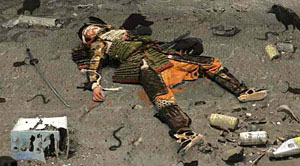
The reference to Kurosawa is present, but it stands out because Western audiences are generally not familiar with other Japanese authors. I would rather refer to Masaki Kobayashi, whose work is more visual, artificial and theatrical. For example, if you looked at the sequence that has the Samurai as its subject matter from a formal point of view, you would realize that it recalls Russian Cinema (Tarkovsky and Youri Norstein) more than it does Kurosawa. So, I would speak of influences because the idea of a reference disturbs me. It becomes evident and pejorative in this kind of visual work. In fact, if I tried to explain these influences I would say that the only reason they are there is in order to place the film within a context. In one word: Japan. We are in Japan in 1945 so I used images that would signify, for the collective unconscious of the viewers, what they would imagine about Japan and about the psyche of a Japanese child: tales, Samurai battles, the Atom Bomb, the ruins, the drama, the dream.
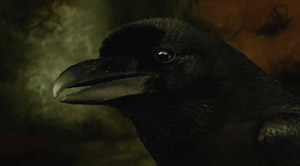
In Tale of the Floating World , there are two levels of reading and composition: the script that creates the texture of the story and the visual composition, which is important symbolically since it delivers several messages such as period, characters and place. In this respect the "Japanese" references only play a symbolic role in representing the Japanese world. In a similar way, Surrealism helped me elaborate the ideas of a world in ruins and of bodily mutations. An important reference for me can be found in the crows' sequence. A real clin d'oeil to Hitchcock's cinema and to the actual Japanese crows that invade the cities at dawn.

IB: The work, in spite of being linear, is different than a traditional short film. Your experimentation with the formal aspects of the image relates closely to video art and to experimental film. Could you please describe your work process?
AE: From the start I wanted a film full of contrasts in a "dreamed reality"; an ambiguous truth between the delirium of the child and the chaos generated by the bomb. I wanted to create a sense of not knowing whether we are facing reality or a post-atomic confusion. The form of the film comes from my background and evolution, and from my affinity with different types of expression. I don't feel limited by one medium. I love all forms of art, and the computer, which I patiently use, allows me to create collages that bridge my different interests. I like to situate my work "in-between". In a space that remains very free.
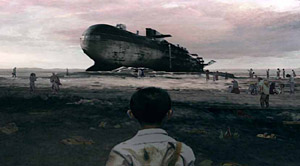
IB: Tale of the Floating World is a digital film shot in diverse formats, elaborated digitally on the Flame and printed on 35 MM film. This process shifts many of the creative decisions (like framing, lighting and even camera movements) from the shooting to the editing. It is striking to see some of the scenes you have created; they include "camera movements" that are entirely constructed in the machine. Some of these shots have several contradicting points of view. Despite the virtual nature of these shots they look eerily "real". Can you speak about the parts that would not have been possible with the use of traditional cinematography and about how you come up with these virtual shots?
AE: This way of working transports the viewer to another world from the very first image of the film. This idea is very important in order to carry the viewer along in an experience that becomes "real" within an artificial world. There's a little strange je ne sais quoi that emanates from the characters. It comes from the fact that I don't give the actors precise directions. Although I do guide them through a world that remains unknown to them. They act in a studio, which is entirely painted blue. A very floating world indeed! Sometimes I tell them anything at all just to get the right expression on camera. Only the result counts. I must mention that in Tale of the Floating World there's no dialogue and that I direct the actors while the camera is running, as they used to do in the times of silent movies. They become somewhat like "human puppets". All this adds to the strangeness of the final result. The film was shot in five days. We had to do it very fast, one day per character. I used four cameras that allowed me to quickly obtain different points of view simultaneously and also to focus primarily on directing the actors. I then spent a year and a half constructing the images, the virtual sets and the camera movements. This is clearly an expensive technique yet it leaves room for incredible freedom in the composition of the film. Freedom for experimenting. I should make clear that I work on all images myself. I don't involve anybody else in this long, solitary process. This makes a huge difference – there's no intermediary between the mental image that I have of the film and the computer.
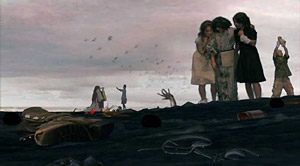
IB: In the narrative of the film you mix different time periods to create an extremely fractured time-line. Could you speak about the construction of the "story" in this work?
AE: The story is told through the eyes of a child in order to merge the idea of ancient Japanese tales and the subject of the Atomic Bomb. This child embodies the drama and becomes the face of all of Hiroshima's victims. Afterwards came the idea of not trying to justify these bridges between the different periods. The viewer never knows if what happens is real and if the space/time is created by the blast or if it is the hallucinations of the child after the bomb. The viewer discovers that the different protagonists, such as the woman from the past and the Samurais, are all gathered at the same place, the ruins of Hiroshima after the bomb.
IB: What was the biggest difficulty in creating this work?
AE: The first one was the dialogue with the actors, especially with the child who was supposed to show only the subtlest feelings. The fact that I worked with several translators obliged me to foresee my instructions for the coming shots. The biggest difficulty was dealing with doubts during the construction of the images. Anxiety, day by day, of what would happen in this crazy adventure taken on alone. Even though my producer strongly supported me from the start of this project. As I make the images myself I never worry about the quality of the work or about the "honesty" of an image – it becomes clear to me soon enough – but as to the final result, that is another story. Especially since the conditions of production were very difficult: I worked at night when the computers were available. I didn't have a social life for a year and a half, it was a heavy cross to carry, as well as a good psychoanalysis.
IB: In your previous videotape, From the Shipwreck, you showed cannibalism on the raft "La Meduse". In this work you speak of Hiroshima. In both videos the search for beauty is striking. Can you speak about the difficulty in evoking horror through beautiful images?
AE: Hum, hum! – My most personal films have always been created during crucial periods of my life. They correspond to a genuine need to expel and to express. I often use my work in a cathartic way in order to chase demons or to express the unspeakable, in order to mature and to pass into another phase of life. I just mentioned psychoanalysis and that term is really precise. It is, I think – no – I am sure, a religious or mystical aspect of what I am. The idea of learning and walking a path to accomplish something. Also, once I have really expressed myself about a subject that has deeply affected me there is always a waiting period through which one needs to pass, to go through – time to live – not to be the same person, in order not to make the same film again. Not to repeat oneself.
Alain Escalle, born in 1967 in the south of France, studied Applied Arts in Nimes as well as Cinema and Video in Toulouse from 1983 to 1989. Director and digital artist since 1991, Escalle developed a visual and graphic style using moving pictures and new technologies with software such as Flame. Following his first film, D'apres le naufrage (From the Shipwreck), and his many trips to Japan, he completed Le conte du monde flottant, which was a finalist at the Césars Awards 2003 and awarded the Grand Prix Imagina 2002.
Irit Batsry is a NY based artist working mainly in video and installations. She was the recipient of the 2002 "Bucksbaum Award", for her contribution to the 2002 Whitney Biennial.
Tale of the Floating World can be downloaded from:
www.escalle.com/tale.html
For more information about Alain Escalle: www.escalle.com