Interview with Mauro Restiffe
by Jeffrey Walkowiak
New York, August 2001JW: Your work, in many ways, lies in the traditional aspects of photography; black and white images, small format cameras, documentary, etc. Why do you choose to utilize photography this way given the technological advances in the medium today?
MR: My professional background is in photography. Though from the beginning of my artistic career I became interested in other mediums, specifically painting and sculpture. I was fascinated with sculpture and its spatial possibilities. The dialogue between sculpture and space had a big influence in the production of my photographs. I began to apply some of the formal and structural propositions of sculpture and installation works to my own black and white photography. It was at this point that I began doing more spatially concerned works. Sculpture plays with space and creates a dialogue with it and this was very interesting to me. This led me to think how I could relate this to the medium that I was most familiar with, photography. My introduction to and interest in the formal elements of photography is steeped in other mediums.
JW: In your most recent exhibition at Henry Urbach Architecture, "In Process", Spring 2002, you address various issues of painting and sculpture through photography. One photograph in particular functions as a sculpture, and in other works you call attention to the perspectival illusion of painting by creating a series of photographs of a Vermeer painting. By introducing these two mediums to photography you create a dialogue that brought forth the relationship that exists between these mediums.
Roebling and North 4th, 2002
Gelatin silver print, 48" X 72",
Courtesy Casa Triangulo, Saô; Paulo
MR: I was interested in that dialogue and how it could be integrated into the space of the gallery. I had two rooms to work with which allowed me to work with both painting and sculpture simultaneously. The way the image of the Vermeer painting was cropped and inserted into the wall space was something very sculptural to me and that was the first step in creating this relationship between photography and sculpture. Another 'sculptural action' I applied to a photograph in the exhibition was the wrapping, again in the Vermeer series. I began to conceal the image. In doing this I broke away from the photographic concern that the significance of an image is the primary focus. I went against photography in a way that allowed the medium to address aspects of sculpture. I hid something that allowed something else to be seen. My attempt was to create a set of reflections. How could one single image become something else? For example, showing an image of a painting, cropped, as a photograph, and then how that image transforms into a sculpture, free of any aspect of it being an image. Photography is not about truths. A lot of my work is about how photographic qualities like this can relate to other mediums and still be very 'photographic'.
The same is true about the photographic images of the Landscape paintings in the other room, where I began to address issues of painting through photography. At this point the notion of authorship also started to be addressed more deeply.
JW: Site and sight are very important elements of your work. How do they inform the final outcome of an image? And with this in mind, how has your move from Brazil to New York had an impact on your work?
MR: One of the most difficult things I confronted coming from Brazil to New York was working without a studio. All the equipment and space I had access to in Saô Paulo was gone. I was not able to further explore aspects of installation and space. I began to take more photographs in NY than in Brazil. I carried my camera with me everywhere. I think it is more natural to receive things as they are and not to stage things with lights and equipment. My new series of photographs entitled "Roebling and North 4th", which at first appears to document the stages of construction of an ordinary apartment building, is not necessarily about documentation. When I take a photograph I have something in my mind, but it is the final image that will allow me to find things that are interesting and relevant to my production. Choosing to print an image has to relate to what I have done before. There are a lot of shifts and contrasts from my past work, but I always want to connect the two.
My earlier works are not necessarily site specific but they do talk about sites and locations. They are more independent from the situations where they will be exhibited. They are more self-contained. I think this new body of work achieves that. It has possibilities of being presented in different ways. It can be exhibited in a gallery in numerous variations or could be presented in a book format. This series of images, in one sense, explores a certain element of photography, specifically its reproduction. It is a series of images of one particular location. It is something I have not done before, photographing the same subject from different angles and at different times of the day. Therefore I believe this new project is somehow less about the site itself, but more about formal qualities and conceptual concerns that I wanted to develop within this group of images of that particular location, which, in itself, is not interesting to me.

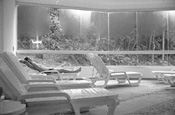
The Aquarium, 2000
Gelatin silver print, 54 " X 81 ",
Courtesy Henry Urbach Architecture, New York
JW: Your most recent work seems to be directly related in one way or another to several of your past works about locations. You also recently participated in the "Brewster Project" which was also about a specific site. Can you speak about the progression of your work and how one series of images may lead to another?
MR: I was making a lot of spatial interventions in my earlier work. Particularly with "The Aquarium", 2000, an image of a man on a lounge chair in front of a window. Behind the window was a garden landscape. This image was a chance for me to speak about natural landscape in an urban environment. In doing so, I began to think about how this image would relate to the space where it would be exhibited. Outside the gallery where the work was first shown, in Saô Paulo, there was a corridor filled with large plants and trees. This was not visible from inside the gallery because of the presence of a wall. I therefore cut three windows in that wall and placed three pieces of glass flushed to the wall to reveal the landscape outside. By doing this I placed the viewer in the place of the figure in the photograph. All the images in the show were about reflection, transparencies, seeing through and revealing. This show evolved conceptually by thinking about the space of the gallery and the space of the image in conjunction.
Some other earlier works were very site specific. I was invited to participate in an exhibition and produce work that was directly influenced by the particular space. It played with the idea of perception of space and how photography could play with that. The space and the images worked together. The works turned out to be spatial interventions.
JW: When conceiving the idea for the "Brewster Project" did you think back to this earlier work that was very site specific and how the work was informed by the location?
MR: The two experiences were very similar. In both cases I created the works based on the site. But, with the "Brewster Project" I thought I did not want to do a spatial intervention or perhaps even a photographic project. The first place I visited was the museum where I saw a historic, panoramic photograph of the town of Brewster, reproduced and presented as a stack of posters. I wanted to recreate this photograph because I responded to the image very strongly. I found a location close to where the original photograph was taken and took a series of pictures. The final piece, which was an updated version of that image, was reproduced in the same fashion (panoramically like but digitally) as the old photograph, and came to be about time and location. This work informed the "Roebling and North 4th" series.
One thing I want to continue addressing in my work is the relationship from one body of work to another. I constantly think of how I can exhaust all ideas for one image and where I can go from there. How can I shift from one perspective to another? I think of how I can use this end as a starting point for the next work. It's an organic process and it opens up numerous possibilities for new work. It opens up my vision and gives me support to try something else.
"Roebling and North 4th" is new for me. Photographing the same site in a series was a problem because I was never interested in working this way. I was more interested in independent, self sufficient images. I feel like I am contradicting myself by doing this new work.
But I discovered with this work that there is a concern for micro and macro. When a group of images in a body of work begin to relate to each other, I then think how I can relate new images to them. This is an example of the kind of connections that I am interested in making. I think photography facilitates that; how looking at one image can open up different possibilities to other images.
Jeffrey Walkowiak is Associate Director of Henry Urbach Architecture and an independent curator.
Mauro Restiffe is a Brazilian artist living in Brooklyn, New York.