Interview with Jeanine Oleson and Ellen Lesperance
by Bernard Yaneloui
Brooklyn, NY, August 2002BY: What did you do before?
JO: A long time ago I did photography. From there I moved into narrative and film, film and video, installations, sound...
EL: I started out as a painter, actually, but that practice quickly morphed into whatever sorts of techniques I needed to learn to undertake the project-at-hand.
BY: Does the work exist in any other way than as photographs? Is there video as well? It resembles film stills or storyboards too.
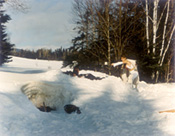
Off the Grid (Winter I), 2001
C-Print, 30" x 40"
JO: It exists only as photographs. It is a return for me, to photography. Ellen was completely out of the realm of photography, so she came at it more from a costuming and prop-making angle. She knitted an entire costume piece out of raffia, for instance. Her use of crafting techniques is part of the piece as well.
EL: I felt so natural doing that part of the project, I felt like I sort of picked up where I left off at age twelve in terms of supporting my love for the fantastic and make-believe.
BY: There's a sensibility in the images informed by pop culture: comic books, "Xena", "Princess Warrior", movies about the "Druids"...
JO: One Thanksgiving we watched "Clan of the Cave Bear" together. We were inspired – it was so perverse! Then we started to think of new images along those lines and also to think how to deal with issues of comfort and spirituality when you can't really do it with any irony. How can we make sincere art work when we're not sincere?
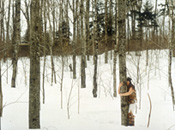
Off the Grid (Winter III), 2001
C-Print, 30" x 40"
EL: Or, what do you do with a crisis of disbelief? Like, when I moved to Maine, I started working with a New Age therapist, whom I loved, but who had me do things that made me very self-conscious and wary.
JO: Like what, Ellen?
EL: Okay, like visualizing a benevolent blue light emanating from the universe into the top of my skull or channeling positivity from friends. I mean, I went along with it, I really, really tried to go for it, but it presents a real crisis.
BY: There is also a great deal of photography on exhibit recently which involves narrative, specifically 'female narrative'. Does your work relate or not relate to such other projects?
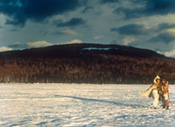
Off the Grid (Winter IV), 2001
C-Print, 30" x 40"
JO: I saw a lot of it and I read a lot about it. I found it annoying that there was no mention of the history of feminist art, or there was a suppression of feminist history: the idea of there being a "post-feminist" sensibility. Part of the irony in the photos is about the premise itself: off in the woods/girls in nature. We were trying not so much to capture the "innocence" at all, but to put another layer on it, that layer being that where there is no irony, or where there is a lot of irony. What is the relation you see?
BY: There are resemblances, but the differences are in the levels of irony. The 'female narrative' work I mentioned may have an oblique or fantastic narrative involved, however the images have a distinct reality-effect. The images are presented as a window onto something that is happening naturally, and the viewer is intended to believe what is seen. Whereas the images you and Ellen have made emphasize a high level of the absurd, improbable and the parodic. Also your sense of adventure is on a grand, mythic scale. It involves the elements, nature, and a sense of the eternal.
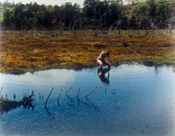
Off the Grid (Spring II), 2001
C-Print, 30" x 40"
JO: Also, this sort of work implies it is a girls' narrative – it is still a category to play with, and be theatrical about. Both Ellen and I are interested in these sort of "icky" movements – New Age, Eco-Feminism - and we bring them up at their ickiest, as metaphors. Why does the culture-at-large hate them so much? Right now, in a way. We pull that out and look at it as a part of the culture too – peel it away, make fun of it, and yet honor too.
EL: Yes, and wondering in public about the possibility of transcendence. New Age beliefs, and much of Eco-Feminism has this presence of magic or at least mysticism. Initially, I think we actually talked about trying to put out our feelers to attempt to sense any sort of presence — whatsoever and however small — of this sort of excess energy.
BY: At the risk of sounding repetitive, I hate to bring up the issues of girls' narratives again, but in a sense those narratives are quite traditional – there's no breaking away, no alternative world being offered, no change in values – there's no social change. There is only the perspective being skewed in foregrounding the experience of the child, the adolescent, the young adult.
JO: I grew up on the West Coast, around a strong hippie culture. As much as I grew up with a sense that this is ridiculous, there were still strong values in all of it. Also, I have the idea that when you make work, you want it to do something for you, in your lexicon in the mind – dealing with irony and spirituality, seeing how it happens. But I think Ellen has a slightly different perspective on the process. I'm more interested in image and narrative, and making a structure.
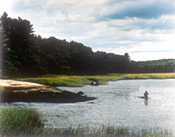
Off the Grid (Summer I), 2001
C-Print, 30" x 40"
EL: And in humor, Jeanine, I think humor is ultimately very important to you. But, to get back to your question about offering an alternate world, I like to think of the project as an imaging of the finding of comfort, and of imaging the idea of persevering. A strict sisterhood is also instated, and that, obviously, adds content. That content can be lesbian, it can be female-privileging.
BY: Do you see this as a storyboard, for a film or video?
JO: It's more about moronic brainstorming. What begins as a joke becomes the resonance of the piece. Let's make a hot tub in the snow. How about an image of washing menstrual blood? A care taking thing for the prehistoric world. In one image I wanted to be like a bear, foraging, or there is one that is a weird reference to "tree-huggers," or we tried to recreate the one existing bit of footage of "Big Foot". There's one frame of "Big Foot" from Super-8 footage out there somewhere. Or we invoke "Where Waldo?" or "Return of the Jedi", or we tried making a unicorn using a miniature horse. These are all simplistic narrative devices. Likewise the images came out of the failure of our initial designs. The absurdity lies in the failure of the situations.
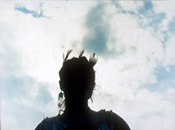
Off the Grid (Summer III), 2001
C-Print, 30" x 40"
BY: Where did you do this?
JO: It was all shot in Maine, over a year. Ellen lived up there, I had been there for one summer, at Skowhegan and I loved the landscape. We had joked for a long time about all sorts of collaborative projects we might do together.
EL: Yeah, we were pretty committed to doing something together, but our brainstorming never really jelled until I moved up to Portland in 2000. Being back in an atmosphere very similar, both in landscape and in ideology, to the Pacific Northwest – which is where I am also from – was the catalyst, I think to finally deal, together, with a lot of issues which had been settling unresolved in both of us, I think. Plus, we missed each other and planning a pretty labor-intensive project kept us in close contact.
BY: Do you have titles, or names, or specific identities for your character?
JO: No. It is coming out of our humor. It begins with our explorations: we go somewhere, hike somewhere, and we don't quite know what it is going to look like. Then when we arrive, we deal with it, in the situation.
EL: But, I do think changing into the costumes does do something to us on some level. It's an attempt at adaptation. I think my character would be someone who has adapted to nature, feels comfortable and capable there. I'm actually a little afraid to even camp!
BY: Curious: If you had told me you had planned it out meticulously, you had storyboarded it out, I would have believed you as well. It reads as well as being very calculated.

Off the Grid (Fall I), 2001
C-Print, 30" x 40"
JO: It is the mysteriousness of the format. With the large format camera, the seduction of the beauty balances the intuitive. It erases any evidence of indecision and likewise the difficulty of the camera itself. Lugging this huge camera out in the woods: It makes you more attentive to framing and exposure, and the situation, juxtaposed with our own performances, and using the camera as part of a process-based art. The 4x5 camera is not usually used for process-based work. It is an unspontaneous medium, used for very spontaneous activities.
BY: Do you have plans for any follow-up?
JO: We are going to a residency at an art center in Florida – for landscape photographers! It should be interesting.
Jeanine Oleson is a film/video, sound and installation artist who has shown her work at the Habana Biennal, Cuba; Galerie Schedler, Zurich; White Columns, NY; the MIX Lesbian and Gay Experimental Film Festival, NY; School of the Art Institute of Chicago, Betty Rymer Gallery; Randolph Street Gallery, Chicago; and Hallwalls Contemporary Art Center, NY. She received an MFA from Rutgers University, a BFA from School of the Art Institute of Chicago, and recently attended Skowhegan School of Painting and Sculpture.
Ellen Lesperance is a multidisciplinary artist who has shown her work at The Institute for Contemporary Art in Portland, ME; The Queens Museum of Art, Queens; The Makor Center, NYC; Artists Space, NYC; Socrates Sculpture Park, Long Island City; Printed Matter, NYC. She received an MFA from Rutgers University and a BFA from the University of Washington and attended the Skowhegan School of Painting and Sculpture in 1999.
All images by: Ellen Lesperance and Jeanine Oleson, copyright 2001